facebook pixel

Want to Know How to Build Brand Awareness, Generate Leads, and Convert Sales?

Want to Know How to Build Brand Awareness, Generate Leads, and Convert Sales?

he short answer is easy: Have a quality product or service, sell it at a reasonable price, clearly communicate what you have to offer, provide excellent customer service — and marketing, marketing, marketing.

The marketing funnel helps you tailor your content to your customer’s journey. In this instance, “content” means several different things — all put together like puzzle pieces that fit to make a cohesive whole. The “whole” is your message. The “pieces” (or content) include the type of marketing tactic (AKA tool, platform, medium) used. These can be a website, a social media post, an email campaign, and so forth. Other pieces of “content” include words and design elements.

An industry-standard B2B marketing funnel looks similar to a sales funnel. However, just as customers face different goals or problems at different points in their user journey, so must your content have different goals at each stage in the funnel.


b2b content marketing funnel


What Kind of Marketing Does Your Company Need?

The answer for you depends on your short and long term business goals, your company’s current position in the market, as well as who your target audience is.

When it comes to advertising, however, it’s usually recommended to strike a balance between lead generation ads and brand awareness ads, as they are the two most important pillars of a campaign.

If you’re a new or new-ish company, a sleek, user-friendly website that clearly communicates who you are, what you do, and why consumers should choose you is Priority One. After that, awareness campaigns are crucial to introduce your product and lodge your brand in your audience’s mind. These are visual campaigns that include graphics, animations, and videos that run as social media ads, Google Display ads, and video ads.

Nine Marketing Tasks to Get You Started

  1. Develop a content marketing strategy that engages your audience and drives conversions.
  2. Use targeted social media platforms to increase brand visibility and interact with potential customers.
  3. Improving your website’s search engine optimization to attract organic traffic and boost search engine rankings.
  4. Create effective email campaigns that keep your audience engaged and drive sales.
  5. Identify and collaborate with local co-brands to expand your reach and build credibility with your target audience.
  6. Use Google Analytics to track and analyze your website traffic and marketing campaigns.
  7. Design and optimize landing pages that capture leads and drive conversions.
  8. Create compelling video content and leverage video marketing to engage customers and promote your products.
  9. Run a cost-effective PPC campaign on platforms like Google Ads and Facebook Ads to maximize your ROI.

This list of nine tasks provides a brief overview of various digital marketing tactics that can help businesses build brand awareness, generate leads, and convert sales.


Marketing Metrics and How to Make Them Work for You

In the past, the sales funnel was a straightforward process that started with marketing and ended with the customer’s purchase. Today, that model has been replaced with a more dynamic model that requires adaptive marketing as consumer trends, digital platforms, and the economic landscape shift.

old world marketing

Now, there’s every opportunity to try new approaches, expand to new channels, and A/B test your tactics. But you won’t know how a tactic is working until you begin monitoring the results. Pay attention to what the analytics tell you, and use the additional information to continue optimizing your marketing strategy.

To evaluate your current marketing campaign, ask the following questions:

  • Are we meeting our KPIs (Key Performance Indicators)?
  • Are campaigns working as intended?
  • Which campaigns are the most successful? Why?
  • Which campaigns aren’t working as we hoped? Why?
  • What did we learn from the most successful campaigns?
  • How can we improve less successful campaigns?

With your evaluations complete, it’s time to take action. Take the opportunity to boost or extend your successful campaigns. For less effective campaigns, decide whether to pause or hit “start over.” You can use your newfound knowledge to improve the tactic or refocus your budget on what’s already working.

The key to adaptive marketing is acting based on the metrics you gather — whether it’s optimizing a campaign or pivoting to an entirely new direction.

What Now? Hire an Experienced Professional Agency.

Liquid Creative can do all nine of the tasks we mentioned — and more!

with services ranging from branding to social media management . . . and everything in between.

Some of the services we provide include:

  • Branding & Logo Design
  • Website Design, Development, Refresh
  • Digital Advertising
  • Social Media Management
  • SEO, Online Ranking, Local Search
  • Copywriting & Graphic Design
  • Photography and Video Production

At Liquid Creative, we are an inhouse team of Operations Managers, Account Managers, Strategists, Writers, Designers, and more — all working together to bring your ideas to life.

If you need marketing assistance to boost your brand and sales, Liquid Creative can help. Contact us today to plan next steps and make the magic happen!


Where You DON’T Want Your Digital Ads To Appear

Where You DON’T Want Your Digital Ads To Appear

Marketing is all about sharing the right message to the right audience at the right time. With sophisticated audience algorithms and more tools than traditional advertising, digital advertising gives you more tools than ever before to do just that. Google, Facebook, and other digital ads have plenty of options for defining your target audience and controlling where your ads are seen.

Being specific about who sees your ads and where is an increasingly important step in making the most of your digital ad campaigns. Where your ads don’t appear is just as important as where they do. Including negative keywords, excluding websites, and choosing content exclusions can safeguard your brand image while making your digital ads more effective.

Why Does Narrowing Your Digital Ad Placements Matter?

In short, showing your ads to the people who are most likely to click on them optimizes your digital ad spend.

The price of digital ads is usually measured in cost-per-click, or CPC. The CPC of your ad is determined by taking your total budget and dividing it by the number of users who clicked your ad.

When you specify your audience and ad placements, you improve the percentage of people who click on your ad after seeing it. This encourages Google, Facebook, and other digital ad platforms to promote your ad by proving it’s valuable and interesting. The end result is an efficient ad spend that earns you more quality leads.


Don’t show your ad in searches for unrelated keywords

When advertising on search engines such as Google and Bing, you may end up paying to appear next to keywords that don’t relate to your business. For example, if you owned a house painting business, you may unintentionally appear in a search for “Painting classes at home”.

Whenever that happens, your campaign becomes less effective. It’s best to avoid it altogether by specifying negative keywords.

What Are Negative Keywords?

A keyword is a search term that you’d like your ad to appear on. A negative keyword is just the opposite – a search term you never want your ads to be associated with.
In the example above, “painting” and “home” would be great keywords to use for a house painter. Using the negative keywords “classes” and “class” would clear up any confusion. Since it’s highly unlikely someone searching for those terms would click your ads, excluding them makes your ad campaign more efficient.

How to check for negative keywords

Even Though you can foresee some negative keywords and add them to your campaign from the start, it’s highly unlikely that someone can think of all the unrelated keywords a person could use next to your keywords.
Once your search campaigns are running, constantly monitor the actual search terms people use that triggered your ad to show up. Here you can find all the unrelated keywords and start adding them to the negative keywords list.


Don’t show your ad next to questionable content

To maintain your brand image, it’s important to ensure that your ads don’t appear next to questionable content. This may include mature content, adult language, controversial videos, political opinion pieces, and more.

Excluding this content from your ad placements can help you maintain professionalism and avoid unintentional associations with negative messaging.

What Are Content Exclusions?

Google and Facebook allow you to choose what content you don’t want your ads to appear next to. On Google, there are three main categories of content exclusions:

  • Digital content labels: This acts as a rating system, from general audiences to mature audiences. Choose which sections of the scale you don’t want associated with your brand. It’s often safest to exclude the most mature category, DL-MA, and content that hasn’t yet been labeled.
  • Sensitive content: Most of the sensitive content labels are beneficial to avoid. These include topics such as profanity, tragedy, and controversial social issues.
  • Content type: You can also choose not to have your ads placed within videos, in YouTube live streams, in games, and more. These are a bit more up to debate, so take the time to review what’s best for your type of business.

Facebook calls their version Content Type Exclusions. You can choose topics such as religious & spiritual, gaming, politics, and news to exclude from your ad placements. In addition, you have the option to remove your ads from live streams, where content is more difficult to monitor and rate.


Don’t show your ads in low quality placements

Your Google Ads, mostly display ads, show up in Google’s Display Network (GDN). This network includes websites, apps, YouTube channels and more, which are called placements. But not all placements are created equal. They range from highly regarded news channels to low quality websites.

We mentioned that you can create content exclusion. For example, you don’t want your ads to show up on kids or gaming YouTube channels. But content exclusion is not perfect and your ad could still show up in placements that you don’t desire.

How to check for low quality placements

Similar to checking for negative keywords, you can check for places your ads appeared in the “where ads showed” Google Ads tab. If you don’t like one of these placements, select them and ask Google Ads to exclude them from your campaign.


Don’t show your ads to certain audiences

Defining your target audience is a huge step in setting up strategic digital ads. It’s helpful to target your ads based on location, age, interests, and more to make sure your ads are reaching the right people. This step should also include choosing what audiences you don’t want to see your ads.

Targeting just the right people can improve your cost-per-click and overall results. Experimenting with ad audience exclusions is a great way to make sure you aren’t spending money advertising to current customers or incompatible audiences.

What Are Ad Audience Exclusions?

Both Google and Facebook have options for removing audience members based on certain characteristics.

  • Current customers: Based on your ad content and objective, advertising to current customers may not suit your goals. For example, brand awareness ads are better served to audiences who haven’t visited your website before.
  • Current employees: Your employees are already aware and interested in your business, so it’s best to exclude them from your audience.
  • Conflicting interests: By excluding users with certain interests from your audience, you can reduce negative feedback and better optimize your ad spend. For example, a local thrift store may choose not to target audiences interested in luxury brands when advertising a sale. Finding a conflicting interest may take some creative thinking, but this step can really narrow your ad audience!
  • Users who have interacted with your brand: If someone has messaged, liked, followers, or otherwise interacted with your account, they’re likely already aware of your brand. Excluding these people, as well as users who may appear in remarketing audiences, can assist with brand awareness objectives.


Looking To Learn More About Digital Marketing?

Liquid Creative has guided many businesses through successful Facebook, Google, and Instagram ad campaigns. With experience with local to national brands, we bring strategy and amazing creative work to every one of our clients.

If you’re a small business owner looking to learn about conducting your own digital marketing campaigns, check out Liquid GROW! This is a new digital marketing course to teach you the basics of Google, Facebook, and other digital ads. If you’d prefer a full-service marketing partner to run your digital marketing from strategy to results, contact us today!

Why and How to Use Video in Your Marketing — with Examples

Why and How to Use Video in Your Marketing — with Examples

In today’s digital landscape, video marketing has become essential to business marketing strategy. With the rise of social media and the increasing popularity of online video platforms like YouTube and TikTok, video has become one of the most effective ways to engage with customers and build brand awareness.

In this blog post, we explain why businesses should invest in marketing videos, the different kinds of marketing videos and how they can be used, and how to create effective marketing videos. We’ll also offer some cool examples for you to check out.


What Is Video Marketing?

Generally speaking, “video marketing” is pretty self-explanatory, right? You use videos to promote and market your brand, products, and/or services. Specifically, this can include anything from product demos and customer testimonials to explainer videos and behind-the-scenes footage of a project. The goal of video marketing is to engage and educate your audience, build brand awareness, and ultimately drive sales.


Why Your Business Should Invest in Marketing Videos

There are many compelling reasons why businesses should invest in marketing videos. According to different studies 1, 2, 3 on both consumers and video marketers, some benefits of video marketing are:

  • Improve Brand Awareness: 95% of marketers say marketing videos help them increase brand awareness
  • Influences Buying decisions: 89% of people say watching a video has convinced them to buy a product or service, and they say it’s the #1 way they discover a brand they later buy from
  • Return on Investment: 92% of marketers say marketing videos got them good ROI.
  • People are expecting it: 91% of people say they are expecting more online videos from the brands they follow.
  • Helps with SEO: 87% of marketers say video has made users stay on their website longer, which is a good SEO indicator


Examples of Different Kinds of Marketing Videos

There are many different types of marketing videos businesses can create. Here are some of the most common, with links to examples you can watch for ideas:

Brand Videos

Showcase a brand’s personality, values, and mission to its target audience. Brand videos typically feature a mix of live-action footage, animation, graphics, and voice-over narration to create an emotional connection with the viewer. They help businesses establish a strong brand identity, increase brand awareness, and improve customer engagement and loyalty. Check out this brief brand video from Straight Line Construction.

Brand video for Straight Line Construction.

Customer Testimonials

Feature satisfied customers sharing their positive experiences with your product or service, which can help build trust with potential customers and encourage newbies to make a purchase.

Client testimonial and case study for Hurd Construction.

Explainer Videos & How-To Videos

Explain complex concepts or processes in a clear and concise manner. With step-by-step visuals to accompany audio or written instructions, viewers are more likely to understand exactly what you’re explaining because they can watch the demonstration. Demo videos are great to teach customers how to use your product or service, which also helps reduce customer support calls and improves customer experience.

Video tutorial for City of Newberry.

YouTube Video Ads

Short video clips that businesses can use to promote their products or services on the world’s biggest video streaming platform. Your video ads can appear before or during a regular content video and are typically skippable after a few seconds. With YouTube’s targeting options, you can reach potential customers who are more likely to be interested in your products or services.

YouTube Ad for Straight Line Construction.

Social Media Ads

Short, engaging videos can be used as ads on social media platforms such as Facebook and Instagram. These can help increase brand awareness and user engagement, plus drive traffic to your website. Similar to YouTube ads, social media ads have very specific targeting capabilities. At Liquid, we’ve found social media ads to be very helpful.

Social media video ad for Liquid Creative.

Animated Videos

Animation is used to tell a story or convey a message. This method can make a heavy topic more palatable for the viewer to watch; it is also useful when you don’t have access to live actors. Often used to explain complex concepts, showcase a product or service, or entertain and engage an audience, one of the main benefits of animated videos is that they are highly versatile and can be used in a variety of settings, from social media to website landing pages. We created an animated video to announce the upcoming show season for the Ocala Civic Theatre, and animation was a great vehicle for the content we were showcasing.

Season reveal 22/23 for the Ocala Civic Theater.

Walkthrough Videos

Tutorials that guide viewers through a product, service, process, or even a location. They can be used to educate customers, increase product understanding and adoption, and improve customer satisfaction. Walkthrough videos can also be used to highlight product features and benefits that may not be immediately apparent in print.

Walk Through Video for Grove Street Games.

Team Intros

Short videos that introduce a business’s team members, showcasing their personalities, roles, and contributions to the company. These videos humanize a brand, build trust and credibility with customers, and create a sense of connection and community. By putting a face to the name, team members become more relatable and approachable, helping to build stronger relationships with customers.

Team Intro Video for Pat Myers Electric.
Other forms of video marketing include webinars, vlogs, behind-the-scenes footage, live streaming, and more.

Subscribe to our Newsletter
Monthly, easy-to-implement marketing tips to improve your website, social media, digital ads, cyber security, and more.

But How Do I Create a Marketing Video?

We’re glad you asked. Now that you know what you need, let’s talk about how to do it.

First, it’s important to understand that video marketing goes beyond creating one-off videos. Brands should integrate video across all their platforms, all the time.

One business that does this well is Straight Line Construction (you saw several of their video examples featured above). Liquid Creative has been working for Straight Line for two years, and we are constantly creating new video content for them—brand videos, team videos, video ads, client testimonials, and social media videos. Because of the effectiveness of this holistic video campaign, we received the Grand Image Award 2022 in the marketing video category.

We know that creating an effective marketing video can be a daunting task. Some of the reasons for not starting doing video campaigns that we’ve heard from business owners include time constraints, they don’t know where to start, lack of resources, lack of expertise, fear of being on camera, or they aren’t sure if the return will be worth the investment.

But creating a video doesn’t have to be difficult. Here are some steps to ensure your video is engaging, memorable, and achieves your marketing goals:

  1. Decide who is filming your video: Are you doing it in-house (with your team and resources), or are you hiring a video production agency?
  2. Determine your goal: Before creating your video, it’s important to know what you want to achieve. Do you want to increase sales, improve brand awareness, or educate your audience? This will help you create a video that is focused on achieving that goal.
  3. Know your audience: Understanding your target audience is key to creating a video that resonates with them. Consider their age, gender, interests, and “pain points.” Pain points include the questions they are asking, the products they need, and the problems they need to solve. Taking the time to discover this information will help you create content that speaks directly to them.
  4. Craft your message: Once you know your goal and audience, it’s time to craft your message. Your message should be clear, concise, and focused on the benefits your users will receive if they choose your product or service.
  5. Plan your visuals: The visuals of your video are just as important as the message. Plan out what you want your audience to see and how you want to present it. This could include graphics, animations, or live-action footage.
  6. Write your script: Your script should be engaging, memorable, and short. Well, brief enough to capture and hold interest—and just long enough to cover the main idea. Most sources suggest keeping the word count around 60–75 for a 30-second video. You don’t want to speed read because you will lose key inflections and emphasis, and your audience won’t understand or remember much of what you said. According to JL Recording Studios, three words per second is an acceptable pace for video script writing. Consider using storytelling techniques to make your video more memorable. Everyone likes a good story, whether it’s funny, nostalgic, or sentimental. And it’s always smart to end with a Call-to-Action of some kind, even if it’s just to get in touch (with your contact info included).
  7. Choose your music & sound effects: Music and sound effects can make or break a video. Choose music that complements your message and adds to the emotional impact of the video. If the script covers a serious subject, an upbeat, happy tune will undermine your message.
  8. Test & refine: Once you’ve created your video, test it with a focus group or a small sample of your target audience. Use their feedback to refine your video and make it even more effective before you publish the video on your platforms.

By now you know that video marketing is a powerful tool to help businesses achieve their marketing goals. With engaging, memorable videos, businesses can increase brand awareness, generate more leads, and improve customer engagement. With the right strategy and tactics, any company can use video marketing to their advantage.

If you haven’t done so already, it’s time to start incorporating video into your digital marketing strategy and see (pun intended) the results for yourself. If you’re interested in working with an award-winning video production agency, be sure to contact us so we can discuss your projects.


  1. The State of Video Marketing 2023. Wyzowl.
  2. The Video Marketing Playbook. Trends & Tips to Create a Video Strategy in 2023. HubSpot.
  3. Digital 2022 Global Overview Report. WeAreSocial.

What Are Users Really Doing on Your Website?

What Are Users Really Doing on Your Website?

You’ve just launched a new website for your business. Now, all that’s left to do is sit back and wait for the leads to come in, right?

Not exactly.

To get the most out of your website, you need to pay attention to how people are using it. Seeing which blogs people are reading, what buttons people are clicking, and even what terms people are searching for will tell you a lot about how you can convert a new customer.

In this blog, we’ll dive into what website analytics you should keep your eye on, what insights they provide about your website, and how to make tweaks to improve your conversion rate.

Must-have Website Analytics

There are many different tools to view your website’s metrics. Although Google Analytics 4 is the most popular one, you can measure analytics with tools ranging from WordPress plugins like MonsterInsights or as part of CRM platforms like HubSpot. With these tools you get an inside look at how visitors interact with your website. While there are a ton of metrics to track, these are the most important ones for understanding how your website is performing.

Sessions

Sessions can be thought of as periods of time when someone browsed your website. From the moment someone lands on your website to the moment they navigate away counts as 1 session, as long as they remain active.

Website sessions are a good metric for understanding how busy your website is. It gives you an understanding of how many times your website is being browsed, not just how many people are visiting. This metric is helpful for understanding how your website is performing in a given time period. Check your website sessions monthly to see if any trends emerge.

Pageviews

Pageviews are the number of times that an individual page was viewed. Anytime someone opens up a page, they add another pageview to your total.

This metric is very helpful for understanding which pages of your website are popular. By seeing which pages are getting the most pageviews, you can understand what information people are looking for, which blog topics perform the best, and which pages might be difficult to find. Use these insights to lean into what works and improve navigation to pages with less views.

Most Visited Pages

The most-visited pages show you what content your audience is most interested in.

This metric can show you which services people are checking out, which of your blogs are creating the most traffic, and what pages people are looking at before they decide to contact you. A high-traffic page presents an opportunity: focus on how to impress your users and encourage action within your most-visited pages.

Session Duration

Session duration indicates how long someone is staying on your website after they arrive.

A shorter session duration could mean that people aren’t finding the content they’re looking for on your website. To improve your website’s session duration, add valuable information and don’t use “clickbait” in your ads or social media. In general, your session duration shows how long you’re keeping your visitor’s attention.

Location

Location shows you the geographic location of your website visitors.

For most businesses, traffic from outside the U.S. should be excluded from analytics results. For local or regional businesses, you may want to see what percentage of your traffic is within your service area. If you’re seeing a high percentage from outside your coverage area, you may need to adjust your marketing or more clearly state your location on your website.

Source

A source refers to where the website traffic came from. This includes if the traffic is direct, organic or paid. If you set up a way to track your campaigns (for example, using UTM codes), you can see which specific campaign brought traffic to your website. This means that you can know if the traffic source was from your social media post, a Google Search Ad, or your YouTube video ad.

This is one of our favorite metrics here at Liquid Creative. If you tie it to the conversion metric (explained in the next paragraph), you can measure which campaign brought your desired conversions and be able to evaluate the performance of each campaign.

✉ Subscribe to our Newsletter
Monthly, easy-to-implement marketing tips to improve your website, social media, digital ads, cyber security, and more.

Conversions Metrics

Some of the most common goals for business websites are leads and sales. When a visitor takes action on your website, it’s considered a conversion. Many service-oriented businesses rely on their website to generate leads, including form fills, email inquiries, and phone calls. E-commerce businesses are more likely to look for online sales.

Unlike the metrics explained before, conversions are metrics that you have to create yourself, based on your goals.

Here are three of the most common and useful conversions:

Form Fills

Form fills refer to submissions to any form on your website. These forms allow users to do things like ask general questions, requesting a quote or a free estimate, ask for a call back, and more.

Most businesses are interested in the quantity of leads they can generate through form fills. However, you should also be aware of the quality. Take note of how visitors are interacting with your form. What fields are they skipping? What common themes do you see? Making your form as fast and easy as possible is likely to increase the number of form fills you’ll receive. Optimize the experience by reducing required fields, adding dropdowns, and being clear about the information you’re requesting.

Phone Clicks

A phone click event activates whenever a user clicks on a phone number on your website. If you coded your website correctly, that click should generate a call. Although this works mostly on mobile, and only if the user clicks on the link (not if they call directly), it’s still an important conversion to evaluate.

Sales

If you are running an eCommerce website, tracking a sale conversion is probably the most important conversion metric of all.

How is your user interacting with your website

So, you designed your website following all the recommended web design trends. Now, which metrics can help you find out how the user interacts with your design? All the metrics we’ve talked about so far may give you valuable information about your user and the actions they take in your website, but they don’t show you how the users interact with each page. Are they liking the design? Are they interacting with it in the way you planned? Are they clicking in places you can’t track with other metrics?

To solve those questions you can use the following tools:

Heatmaps

Heatmaps show how users move and click around on your website.

A heatmap is a great way to evaluate user experience and interest. Pay attention to where people are clicking and where they aren’t. For least-clicked areas, make sure your language is clear and users know what to expect after they click. On the other hand, your most-clicked areas show you new opportunities for expanding your website content.

Session Recordings

Session recordings are actual video recordings of your user interacting with your website. You’ll get a screen video capture of important information like how they scroll, where they move their mouse, in what places they spend more time, and how they go back and forth in between pages.
For privacy reasons, you will not know who the person is or access important information they fill in forms, like phone numbers or credit cards.

Analyze, Strategize, and Optimize

Improving your website is a continuous process. Updating your website, adding content, and improving usability will both improve your SEO and convert more visitors into customers.

Using the metrics above to analyze your website, strategizing ways to improve it, and implementing those changes should be a cyclical process. At Liquid Creative, we develop stunning business websites while always strategizing our next step. We can improve your existing website with intentional updates, improve your SEO with monthly blogs, or even create a personality-filled site from scratch.

Our website team prioritizes strategy and usability to earn you the most calls and clicks. Learn more about how we can help you impress and convert your website visitors: Contact us today!

Agency or In-House Marketing Team: Which Is Better for Business?

Agency or In-House Marketing Team: Which Is Better for Business?

Any company that wants to grow needs to take their marketing efforts seriously. Successful marketing is both comprehensive and consistent, which is why it yields desired results. In this article, we share important pros and cons of various levels of marketing services to help you determine what kind of marketing is best for your business goals.

For this article, we only consider strategic, ongoing marketing efforts. This means we won’t be addressing one-off projects that might require the hiring of a web designer or photographer. In the end, this blog can help you decide whether to hire a marketing agency, create an in-house marketing team, or utilize a hybrid model.

Partnering With a Marketing Agency

Any type of business will benefit from hiring a marketing agency, but it’s especially beneficial for small and medium businesses, who may not be positioned to hire a professional in-house team with sufficient marketing experience and expertise.

Pros of Working with a Marketing Agency

Expertise: Marketing agencies have a breadth of knowledge in multiple areas of marketing. Because of their vast knowledge and skill set, they are able to create professional campaigns with goals, objectives, strategies, and tactics. Furthermore, they are then able to plan, implement, and monitor those campaigns.

Experience:

From years of creating multiple campaigns for various clients in different industries, marketing agencies have irreplaceable practical experience in what works and what doesn’t. Therefore, agencies are better suited to anticipate problems and troubleshoot solutions (which can also save the client’s reputation, not to mention time and money).

Flexibility:

Having a multidisciplinary team with talents in different areas allows an agency to offer the marketing mix that produces nearly any deliverable and achieves any outcome . . . for any kind of company.

Scalability:

If you plan to grow your business, but you are not yet where you want to be, an agency can easily scale your marketing efforts to match your budget and then increase your campaigns when it’s the right time to do so.

Advanced Tools and Technology:

Agencies have access to specialized tools that optimize every part of your marketing campaign with no additional cost to you. These tools include everything from design software and analytic programs to state-of-the-art computers, video production, and print capabilities.

Access to Resources and Providers:

Agencies constantly work with external companies in advertising and media relations. These connections will get you better and faster deals than what you could have negotiated on your own.


Cons of Working with a Marketing Agency

Finding the Right Fit:

Partnering with an agency is a big commitment. It may be a hard decision to choose one over the other, and choosing the wrong agency could generate lasting problems for your brand. We recommend you take your time, do your research (ask previous clients about their experience), and make an informed decision.

Potential Conflicts of Interest:

A marketing agency you prefer might already have contracts to work with competing companies in your industry. It’s a smart and savvy legal move to address and clarify any potential conflicts upfront.

Cost Considerations:

Agencies tend to set flat rates for consistent deliverables (the same tasks done each month on a retainer) or an hourly rate for the work they do. If you want additional tasks or to make modifications to what has already been agreed upon, you will probably incur additional costs.

✉ Subscribe to our Newsletter
Monthly, easy-to-implement marketing tips to improve your website, social media, digital ads, cyber security, and more.


What Is an In-House Marketing Team?

An “in-house” marketing team is when a company has people on staff whose sole responsibility revolves around marketing that company, and that company alone. For example, an insurance company might have brokers, auditors, and managers, but if they have an in-house marketing team—those are employees who specialize in marketing and work to promote that insurance company and their products on a daily basis.

The ability to afford an in-house marketing team is usually reserved for big companies that have the need (an ongoing large amount of diverse marketing materials for multiple campaigns and target audiences) and budget to manage their marketing internally.

Pros of an In-House Marketing Team

An in-house team is more familiar with the brand, since their marketing efforts are 100% devoted to that company. They are often physically present at the company, spending time with the company staff, hearing the “voice” of the company everyday. Also, they tend to use the products firsthand, and never work for another company that might divide their attention.

In-house teams have the flexibility to start, stop, and change campaigns at any moment without needing to ask an outside agency for a new quote or wait for an agency’s calendar to open up—all of which results in faster delivery time.

In-house agencies are “closer to the product” and ready to market at all times. For example, they don’t have to wait for an email letting them know that Bob had delivered a great presentation at a national trade show. Why not? Because Bob knows he had provided valuable insights, generated lots of leads, and is ready to post spur-of-the-moment content—like a TikTok reel or Facebook story.

Cons of an In-House Marketing Team

Let’s go back to the example of the insurance company. While experts in their field—and super knowledgeable about all kinds of insurance policies, premiums, and coverage—does anyone on staff know enough about marketing to hire the right people for their in-house marketing team? Can they properly assess the qualities of a graphic designer, copywriter, digital marketer, video producer, web developer, or a social media manager? Chances are, most of these positions and skill sets are too far out of the insurance area of expertise that the HR department won’t be sure if they are hiring the right people for each position.

The previous point means there may be several cases of hiring the wrong people. They had a resume that said the thing, but their skill set just didn’t hit the mark. Having to fire people is expensive, difficult, and could damage employee morale.
For every person on your in-house team, you have to factor in recruiting costs, salary (wage, benefits, insurance, 401K, etc.), physical space in your company, training, hardware (computers, cameras, etc.), software licenses, and more. The costs add up—and fast.

You may need to hire new people for every new type of campaign. If you want to do something you’ve never done before, your in-house team may not have the experience or the equipment to do it properly. Hiring new people with a new skill set or buying additional hardware and software just adds more to the budget.

Hybrid Marketing Model

Given all of this information, many midsize to big companies opt for a hybrid model, where part of the marketing is done in house and part is done by partnering with a marketing agency.

Although the personnel configuration varies with each company, many businesses with the means to do so will employ a full-time marketing director with a great understanding of the brand, in depth knowledge of the company’s goals and needs, and enough knowledge to be the right liaison between the company and the outside marketing agency.

Companies also choose to have some in-house team members for specific tasks or projects that are extremely detail-oriented, time-sensitive, or require the employee to be physically on site at the company.

How to Choose the Best Marketing Option for You

Here’s a short list of things you need to consider when evaluating your options. What feels more natural and realistic for you and your business objectives? Partnering with a marketing agency or building an in-house marketing team?

marketing podcast generalist vs specialist

For more insight on options, check out our Liquid Marketing Podcast “Generalists vs. Specialists.”

Before you decide, be sure to research the following for clear data on your company’s current health:

Overall Budget:

How much do you have available to spend on marketing?

Specific Needs:

What’s the most important thing to market right now? Do you need brand awareness, to get your name out there? Do you need a website? Maybe you need leads so you can sell products?

Agency Options:

Have you found an agency that does good work and has great communication/customer service? Do you vibe well with their team? How much do they cost?

In-House Options:

Do you have enough people on your team right now who have the right expertise to meet your marketing objectives? If not, the money spent on a marketing budget or new hires might be wasted.

If you need help choosing an option or are in the research stage for hiring an outside marketing agency, contact Liquid Creative. We’re here to answer any questions you might have—and, ultimately, help propel your brand through inspired and adaptive marketing, whatever your business, whatever your need.

A Handy Guide to Content Marketing Lingo

A Handy Guide to Marketing Lingo

It’s not just the marketing industry — every field has its own jargon, acronyms, and “language.” Knowing what’s what and how to speak the lingo as you move through different contexts and settings is often called “code-switching.”

With so many marketing terms that even agencies and marketers sometimes casually use words or phrases interchangeably, it can be challenging to understand the language well enough to accurately hire for the end product (AKA “deliverable”) you really want.

And if the person assigning the task and the person completing the task are using the same terminology to mean two different things, that’s gonna cost you time and money in the long run. So this blog provides an insider’s dictionary that will help you protect your business budget and better achieve your marketing goals.

What Is “Content Marketing”?

Content Marketing involves strategically planning, creating, and publishing content to promote your company, increase brand awareness, and generate business.

Generally speaking, “content marketing” covers a wide range of tasks that can be boiled down to this basic definition.

However, content marketing is less about explicit product advertising or time-specific promotional materials and more about a focused and concerted effort to attract a particular audience. The point is to engage with potential clients by consistently providing relevant and valuable content in order to build and maintain lasting relationships.

What Does “Content” Mean in Marketing?

In marketing, the term “content” typically refers to both words and images. These images can be any kind of visual element created with software programs (like Adobe InDesign, Canva, or CorelDRAW); they can also be organic or stock photography, video, and so forth.

If we want to be more technical, then instead of saying “content refers to both words and images,” we’d say content usually includes both copy and design. Some people might say that content includes both text and design.

However, people in other industries besides marketing, journalism, and publishing usually think of Xerox when the term “copy” is mentioned. And since the advent of cell phones, most people think of messaging apps when the word “text” is used.

So, if it helps, instead of fancy lingo like copy and text, just think of it as “words” for right now. And in this particular blog, we’re only going to focus on the words-side of “content” — not the visual graphic design part.

Hold On


But hold on! Don’t just think of “content” as written words requiring readers. Listeners and viewers are still influenced by words, because brand anchor videos or promo vids or podcasts or commercials are all born from scripts AKA words AKA content.

Got it? Great! We’re almost done.

Different Kinds of Digital Content or Print Collateral

Content is super important when it comes to marketing, even though it sometimes gets short shrift because folks are tempted to think they don’t need to hire a pro to write words. Too often, they save their marketing budget for graphic design or web development. After all, business owners and employees speak the language, so they can just write the words themselves!

It’s too simplistic and often a mistake to approach content this way. There are so many different kinds of content — each with its own specialized audience, purpose, tone, and style — that hiring a professional writer or a marketing agency with writers on staff is often the best way to achieve your business goals.

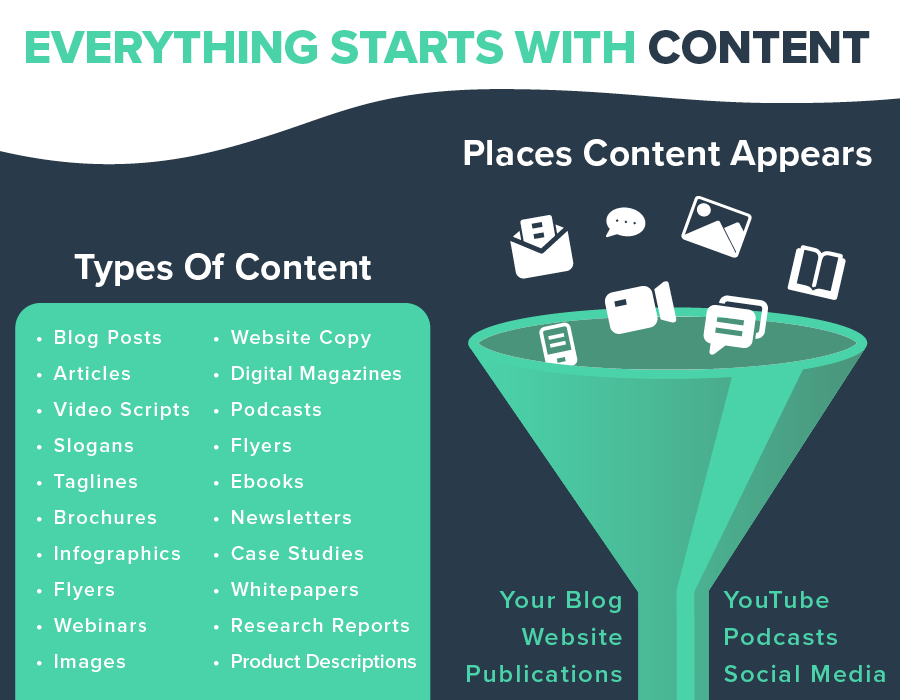
content marketing types and placements

The Difference Between Copywriting and Content Writing

Wait! Don’t confuse “copywrite” with “copyright.” The first term has to do with a professional writing words, and the second term is a legal designation protecting someone’s words as their property.

It’s important to understand the difference between content writing and copywriting, so that you assign the right scope of work (SOW) for your business aims.

Even though some marketers use “copywriting” and “content writing” interchangeably, they are not the same thing and result in different levels of writing for very different deliverables (AKA end products).

Here’s an Easy, though not exhaustive, infographic to help remember the distinction:
Copywriting Content Writing
Short Form usually requires less time, less research, and different skill set Long Form usually requires more time, intensive research, and different skill set
Promotional materials largely based on information received from the client and primarily used to persuade in one or more of the following ways: generate leads (lead gen), humanize a company, quickly build brand awareness or interest, etc. Brand-aligned digital or print materials largely based on research that incorporates multiple assets and is primarily used to explain a product or service, share detailed information about the company, build brand trust over time, engage or entertain the target audience, cultivate relationships that result in sales.
Examples:

Slogans & Taglines

Sales emails

Ad copy:

  • Pay-per-click (PPC)
  • Search ads
  • Display ads

Social media posts

  • Employee spotlights
  • Behind-the-scene photos
  • On location video shoots
  • Carousel ads & Stories ads

Brief web copy:

  • Value propositions
  • Image descriptions
  • Single landing page
  • Fillable forms
Examples:

  • Web content (full site)
  • Blogs posts
  • Articles
  • Digital newsletters
  • White papers
  • Case studies
  • Reports
  • Brochures
  • Flyers
  • Email campaigns


Ch-Ch-Ch-Ch-Changes

Similar distinguishing levels as those used in creating content also apply when making changes to the content. Often lumped together as “edits,” there is a difference between revising, editing, and proofing. Each level requires increased time and skill — and cost — so know what you want when hiring or adding these steps to your process cycle.

Revise: Global, big changes to overall direction of content. Example: Instead of writing about metal roofing, we’re going to write about bathroom remodels. Another Example: The client gives the writer a topic and perhaps an outline or rough draft and wants the writer to add new content or cut current content based on credible, relevant research.

Edit: Local, smaller changes that leave the overall direction of content intact and focus on grammar, diction, syntax, and other writing (technical) issues. Example: The original text from the client mixeds past tense and present tense, so the hired writer makes verbs consistent but doesn’t add or cut content.

Proof: Micro level typo corrections that anyone could/would spot and fix if they were in the project loop. (This step is sometimes called “QC” for “quality control.”) Examples: The year is 2022 instead of 2023. The page numbers are off. The word says “god” instead of “dog.”

How to Optimize Content for Search Engines — and More

No matter the type of content being written, it should be optimized for search engines (SEO) and published when and where it makes strategic sense according to market research. Wanna learn more about local SEO strategies? Check out the following articles: Get Found In Local Google Search Results and Stay in the Know About SEO: Upcoming Changes That Will Affect Your Ranking.

And regardless of the type of content you’re writing, it should be compelling, which means it should move the audience to an intended action that serves your overall business objectives. Stay tuned for next month’s blog, “The Six C’s of Compelling Content,” and discover how to ensure your content always hits the mark.

If you need marketing help in the meantime, Liquid Creative is always here.

Avoid These “Facebook” Phishing Scams—or Risk Losing Your Account

Avoid These “Facebook” Phishing Scams—or Risk Losing Your Account

Liquid Creative is well aware of the recent increase in phishing scams from devious people impersonating Facebook and Meta. We’ve received these emails ourselves‚ in our Liquid accounts and the multiple accounts we manage for clients. Sadly, some of our clients and loved ones have been fooled by these tricks. Thankfully, we’ve been able to recover most of the accounts. Sometimes, it’s just not possible.

What are Facebook phishing scams?

Phishing is a common internet crime, where a scammer impersonates a company, government agency, or even a person you know, and tricks their victims into sharing personal information like the login information to their accounts. Then the scammer proceeds to take control of those accounts for their own benefit.

Facebook phishing scams usually show up in one (or all) of these three ways: as a direct message through Facebook or Instagram (Messenger), as an email, or as an SMS text message. In all cases, the sender often impersonates Meta, Facebook, or Instagram.

Common phishing scams targeting Business Pages

The following isn’t an exhaustive list of phishing scams that target Business Pages, but it gives you a good idea of what to watch out for:

Facebook will never ask you for your password in an email or send you a password as an attachment.

  • Claims that your page has gone against Meta’s community standards, and that your account will be blocked if you don’t act.
  • Claims that your page has violated copyright laws, and that you will be sued if you don’t act.
  • Warnings that your account has been compromised or hacked, and that you need to log in to recover it.
  • Questions about a product or service with a fake link, or a request that you download a file (that’s infected).


Common phishing scams targeting Personal Profiles

Since your personal profile is tied to your business page, scammers only need to gain access to your personal account (or any admin’s on your business page) to be able to access your business account. To do this, scammers often use these types of techniques that target personal profiles:

  • Impersonating someone you know
  • Friend requests
  • Contests and giveaways
  • Job offers
  • Surveys
  • Games and quizzes

Click on these scams, and you’ll likely land on a website that looks like a Facebook page (or actually is a Facebook page), but is a fake one created to impersonate an official Meta account. In each of these scenarios, the scammer requests some kind of access and then uses it to take control of your account and lock you out.


What happens after my account has been hacked?

One of the worst things that can happen when your account gets hacked is this: Scammers then use your Ad Account to run ads for their own products and services using your credit card.

They can also impersonate your account and reach out to people or companies you know and scam your colleagues too!

Just losing access to a business account that represents your brand and that you’ve probably worked hard to build is bad enough, but it’s not the worst of it.
 

You might be interested in: What Is Adaptive Marketing?


Is this message from Facebook legit? Examples of different phishing messages and how to recognize them

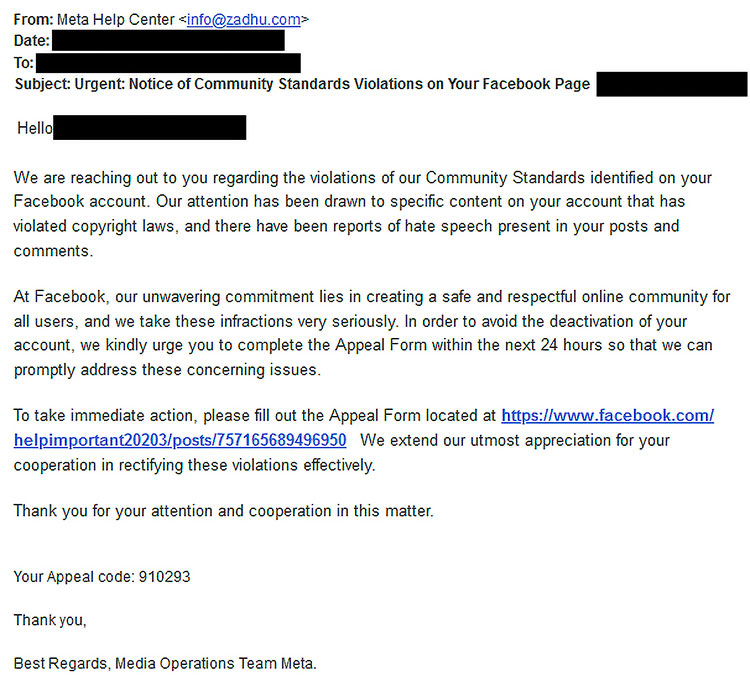
Example of a “Meta email” phishing scam

This email received by one of our clients is a good example of a phishing scam where the sender pretends to be the company Meta. The email “From” line claims the email was sent from the Meta Help Center, but if you look at the accompanying address, the email is actually from zadhu.com.
The email includes the actual name of the business page on the subject line and in the content. It claims you violated community standards and copyright laws. Then it warns that if you don’t act within 24 hours, your account will be deactivated.

It includes a link to a Facebook page. The link will take users to a fake Facebook page that impersonates Meta. From there, they’ll ask you to give them enough information to take control of your account.

Example of a Facebook Meta email phishing scam


Examples of direct message phishing scam

Similar to the email above, you can get a direct message via your phone app or on your computer. In this case, the message will be from a user that claims to be Facebook or Meta. They will probably use Facebook’s logo and/or some kind of warning sign.

Examples of a Facebook direct message phishing scam

You may also receive a message from someone impersonating a user who pretends to be interested in your products or services. But, they will send you a link or a downloadable file.

Examples of a Facebook direct message phishing scam

Example of an SMS message phishing scam

Similar to the examples above, you may get a text message with the same modus operandi. You’ll start to notice the pattern, and you’ll be ready to ignore, block, delete, or report!

Example of an SMS message phishing scam

How to detect a phishing email or message

Here are some of the most common warning signs:

  • Email is not from a Facebook or Meta domain. Facebook uses the following emails when reaching out to users: @facebookmail.com, @facebook.com, @fb.com, and @meta.com.
  • Typos, grammatical errors, unusual fonts, or excess of emojis ⚠️ 🚫 🚩
  • User’s name or avatar is not from Facebook or Meta.
  • Design doesn’t look like it comes from Facebook or Meta.
  • Time-sensitive requests (e.g., “Do such and such, or you will be suspended in 24 hours.”).
  • Links you have to click to solve the stated problem.

Please consider that scammers are becoming increasingly effective at impersonating official messages, so always take extra precaution.
 

Subscribe to our Newsletter
Monthly, easy-to-implement marketing tips to improve your website, social media, digital ads, cyber security, and more.


What to do if you suspect you’ve received a scam email or message

Our recommendation is to NEVER click on an email or message from Facebook. If you wonder if the email or message is legitimate, you can log into your personal profile, your business page, or your business manager account directly and make sure everything looks good. If there is a problem with your account, you’ll probably see an official warning message from Facebook in the account itself—not via a text, direct message, or email.

If you are sure it’s a scam, you can:

  • Delete or ignore the message.
  • Mark it as spam.
    Example of how to mark an email as spam in Gmail:

    Example of how to mark an email as spam in Gmail:

    Example of how to mark a direct message as spam in Meta:

    Example of how to mark a direct message as spam in Meta
  • You can take the extra step and report it to Meta. You can do that by forwarding it to ph***@**.com, or you can report it on this page.


What can I do if I fall for a Facebook phishing scam?

If you or someone you know already fell for a phishing scam, the most important step you can take is to contact Facebook and tell them. Follow the instructions on this page or through Facebook’s chat support (you need to still be able to access your personal profile and be logged in to do this).

If you are not sure if your account was compromised, you can reach out to this Facebook page.

If you have a credit card attached to your Ad Account, contact your bank and cancel your cards.

If you have a credit card attached to your Ad Account, contact your bank and cancel your cards. Also verify whether or not the cards were used for any unauthorized purchases. If the cards have already been used, you will need to file an appeal with your banking or credit card company. If they haven’t been used yet, still cancel them and get new cards.

Take all kinds of screenshots that can be used as proof—for your financial service, your own company records, and Meta. This includes emails, direct messages, and any kind of actual warning you’ve received from Meta once your account was hacked.

If you have questions, we have answers. You’ve got business objectives. We’ve got marketing solutions. Contact Liquid Creative today.


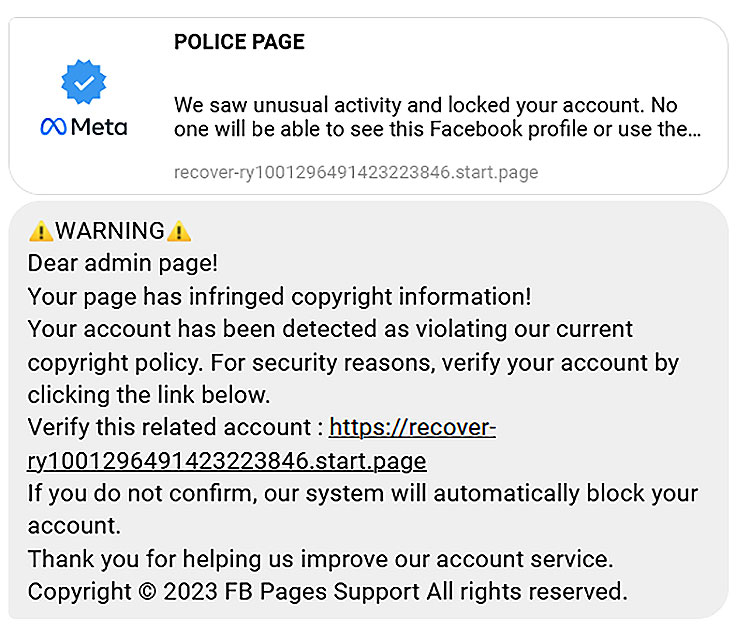
More example of phishing scam messages

example of phishing scam fake messages

How The Holidays Affect Your Digital Campaigns

how-the-holidays-affect-your-digital-campaigns-6784519

The last two months of the year are a wild ride for digital ad campaigns. During the holiday season, we have Black Friday, Cyber Monday, and holiday shopping one after another.

Running campaigns during this time can be crucial to reaching a market that’s ready to invest for the New Year or splurge on family and friends. But this season of spending also can make digital marketing a bit more challenging because it significantly increases digital campaign costs and changes user behavior.

How does the holiday season affect your business?

Prepare for changes to your digital advertising this holiday season! We’ll cover a few topics to help you tweak your digital marketing strategy for the end of the year:

Why do digital ad costs increase during the holidays?
How does user behavior change during the holidays?
What type of companies benefit from holiday advertising?
What can your business do to be prepared for the holiday season?

Why do digital ad costs increase during the holidays?

Q4 ends with two big events: Black Friday/Cyber Monday at the end of November and Christmas at the end of December. Both occasions can result in increased consumer sales for B2C businesses. Companies that benefit from holiday sales increase their digital advertising budget to reach more consumers. With this increasing demand for digital ads, the cost of placing digital ads also increases. Since digital advertising works as online auctions (see how digital advertising costs work), the higher the demand over a limited supply of ad space, the higher the price of an ad.

Costs usually start increasing at the beginning of November. You’ve probably seen big brands promoting their Black Friday deals as soon as the day after Halloween. The increase is usually gradual, but you can expect to see over a 100% increase in digital advertising costs by the end of November.

How does user behavior change during the holidays?

While the cost of digital ads is higher during this season, so is buyer activity. User behavior changes drastically, with an emphasis on discount-seeking starting in November. In addition to wanting to buy more items, users also want to buy at reduced prices. Everyone is looking for offers, sales, and discounts—especially on items they’ve been waiting to buy. As December approaches, buying behavior focuses on Christmas gifts and other holiday-related purchases.

Online search for discounts
Online search for discounts during the recent years. Each peak happens around the last week of November. (Source: Google Trends)


The holidays put people in a unique state of mind. Celebrations, family reunions, gift-giving, and the close of another year shift people’s priorities. While buying for certain categories will skyrocket, other products and services won’t be considered until the New Year, often due to increased spending in other areas.

What type of companies benefit from holiday advertising?

Some companies see this time of year as a curse and others as a blessing. Where your business fits should impact your Q4 ad strategy and budget.

Companies that benefit from the holidays

B2C e-commerce companies usually benefit from the holiday season, especially those that sell products and services that are in high demand during this time. If an e-commerce business can maintain a profit while giving a big discount, they’re sure to rake in some sales from online discount shoppers.

If this sounds like your business, increase your ad spend for a healthy return on investment. Some direct-to-consumer companies depend heavily on their end-of-year sales, making this a huge event accompanied by a large digital ad spend.

Companies that don’t benefit from the holidays

There are roughly two kind of companies that don’t benefit from this holidays:

B2C companies with more complex products and services. With a more involved decision-making process or a higher price tag, some consumers will put these purchases off until their bank accounts recover from the holiday season. For businesses with low margins, offering big discounts isn’t viable, which makes it likely that consumers will hold off on buying from them.

B2B companies. Businesses that don’t directly sell to consumers rarely see a benefit in this season. Decision-makers in businesses might be taking time off, preparing for a new fiscal year, or focusing on implementing their own advertising strategy.

Subscribe to our Newsletter
Monthly, easy-to-implement marketing tips to improve your website, social media, digital ads, cyber security, and more.

What can your business do to be prepared for the holiday season?

If your business is unlikely to see a direct benefit from the holidays, here are some tips on how to be prepared.

Find a way to get into the holiday spirit

Not every product or service is the perfect Christmas/Kwanzaa/Hanukkah gift. However, there’s often an indirect way to tie the holiday season into your marketing. Offer a discount or include holiday elements in your copy and graphics. Doing so will help you capitalize on the seasonal state of mind that shoppers are in when they’re browsing online.

Be aware of the cost increase

Many businesses keep their campaigns running without much change. Being aware of cost increases and less effective results helps you tweak your strategy. If two months of low-performing digital ads won’t bother you, don’t change the strategy that works in other months of the year.

Shift your budget

If you are not getting the same ROI as the rest of the year, you can invest your ad spend differently. Although stopping your campaign is not recommended, scaling down your ad spend budget can be helpful—especially because you can reinvest that capital in Q1. When shifting your budget, consider improving other marketing materials, or start Q1 with an additional boost.

Looking to adapt your ad strategy for the holidays?

Adjusting your budget and trying new digital ad strategies is essential for effective ads during this time. For an adaptive digital ad strategy complete with high-quality executions, look no further than Liquid Creative! We use our marketing experience to give you the best recommendations for your business’s digital ads. Contact us today to learn more!

Building Trust: The Importance of Establishing a Positive Online Reputation for Your Business

Building Trust: The Importance of Establishing a Positive Online Reputation for Your Business

With the rise of conspiracy theories, impressive AI capabilities, and realistic deep fake videos, the need to build trust online has never been more critical to your business success.Clients and consumers need to know who you are—who you really are—so they can have faith in your company and count on you to come through for them.

And so that if something were to go wrong (fingers crossed it doesn’t!) and your site or socials get hacked, you’ve already built a solid reputation people can trust.


It all starts with a trustworthy website

When it comes to establishing an online anything, you’ve got to start with a website. Start with a trustworthy website, and you will take a giant step toward establishing a positive online reputation for your business.

What’s a trustworthy website? A quality, professional, easy-to-navigate website that contains all the pertinent information about your business. (Custom photography instead of stock images always helps too because it shows the “real you.”)

Your website should be the backbone of your online presence, and for that to happen, it must feature:

  • Good Design: First impressions matter. Studies show that it takes a person less than one second to make a subconscious decision on how they perceive the credibility of a website.
  • Clear & Concise Messaging: After the first impression, you have only a couple moments more to present the brand. We recommend starting with a stellar value proposition, which is marketing-speak for one or two succinct sentences that sets you apart from your competitors by stating (front and center, big and bold, on the homepage):
    • who you are
    • what you do
    • where you do it
    • who you do it for (AKA target audience)
    • how people benefit by choosing you
  • Testimonials, Case Studies, Project Portfolios: Each of these are excellent ways to demonstrate that you not only talk the talk, but you also walk the walk. Any company can claim to be the best, but results don’t lie. If you’ve got ’em, use ’em.


Manage your local presence with Google Business Profile

With a Google Business Profile (GBP) a business can dictate the information displayed about them on all of Google’s services like reviews and maps. To learn how to set one up, check out this informative article from Business News Daily.

Of course, Google isn’t the only show in town. There are many other local citation platforms, like Bing Places for Business and Apple Business Connect. But with an online search market share of over 85%, you should probably focus on Google.

To prove you’re proud of your business and not afraid of what folks might say, you should encourage customers to leave reviews — especially happy customers. Unfortunately, research shows that people are more likely to take the time to visit your GBP to leave a negative review than a positive one. It’s just human nature; anger is a stronger motivator than happiness. Research also shows that it will take multiple positive comments to undo the damage of a negative comment.

Google Business Profile

What can you do to help yourself? You can respond to all reviews in a timely and professional manner. For the stinkers, offer an apology that doesn’t admit fault to any of the reviewer’s claims but does validate their feelings. For example, “We’re very sorry to hear this because we strive to offer top customer service.” Something nice deescalates the situation and goes a long way to putting out the fire.

Then offer a phone number, email address, or direct message option for them to get in touch with you. Try something like, “Please contact us directly so we can better understand what happened and work to make it right.” This takes the conversation out of the public eye, except that everyone else reading the reviews will see your proactive kindness and willingness to assist customers.

Handling positive reviews is easy — copy and paste those winners far and wide, sharing them on all your platforms, like your website or as part of social media post copy. This public proof from other people tooting your horn will help users trust your brand more.

Subscribe to our Newsletter
Monthly, easy-to-implement marketing tips to improve your website, social media, digital ads, cyber security, and more.

You need to be present — and active — on multiple platforms

Like it or not, social media is here to stay. Sure, there are different platforms that cater to different demographics, based on several factors such as age, gender, location, and needs. But statistics show that “the world spends roughly 11.5 billion hours using social platforms each day,” so it’s probably a good idea for your business to get on board.

Overview of Social Media Use

Source: “Global Social Media Statistics” DataReportal.com

Your absence on the important platforms will lower your brand’s credibility from a user perspective. Think about it: When you want to know about a new company, what do you usually do? You look them up online. And if they’re not on social media, 🚩🚩🚩❗

Here are some of the basic platforms you need (the list may increase or change depending on your industry and audience):

  • Your Website
  • Local Citation Platforms
  • Social Media Platforms
  • Search Engine Results
  • Review Sites

And, remember, don’t build it and forget it. You need to have an online presence, and you also need to be active online. Post to social media regularly, consistently update your website’s blog, and update images on your Google Business Profile.


Decide where to market your brand on social media

Now that you know you need to be present online and active on social media sites, the next logical question you’ll likely ask yourself is, Okay, but where? What is the right social media platform for my business? Great question!

It really depends on what kind of business you are, who your primary audience is, and what goods and/or services you are selling.

This infographic may help demonstrate what we mean, especially the second column “Follow or research brands and products”:

Social Media Ctivities by Platform

Source: “Global Social Media Statistics” DataReportal.com


Give your users a consistent experience across all your platforms

It’s not only important to be present on multiple digital platforms; it’s just as important to give users a consistent experience on all of them, since studies show that users expect a unified user experience from brands.

Since you have very little control over which platform will be a user’s first contact with your brand, make sure you’re following best practices on all of them. Two biggies are cohesive branding and consistent customer support.

  • Cohesive Branding: Create cohesive branding on multiple platforms. Users may quickly switch from your Google Business Profile to your website to your social media channels. Is your company’s brand the same on all of them? Staying consistent with your logo, tagline, colors, image style, content, and even the tone of your content will help the user trust your business more.
  • Consistent Customer Support: Be consistent with your customer support too. Can a user contact you on every platform? Are the contact options the same? Do you reply using a consistent modality with consistent content whether the customer calls on the phone, sends an email, fills out a form on your website, direct messages your Instagram account, or comments on your Facebook post? Failing to provide the same quality experience across all platforms can cause customers to lose trust in your brand.


Show-and-tell isn’t just a game children play

It’s a common refrain in writing workshops: “Show. Don’t Tell.” Successful authors and script writers know that too many words can weigh the reader down or bore the viewer enough to lose interest. Then the user is off to something else before you get your point across. Even Elvis asked for “a little less conversation, a little more action, please.”

But in marketing, you want to show AND tell. Aligning words with images/video is another way to keep your branding cohesive. It also adds interest for your viewers, since some people learn by reading, and others are visual learners or auditory learners. When you show AND tell, you satisfy more people with your content.

Most likely, you’re competing with multiple companies that offer similar services or products. In the eye of a new customer that is evaluating multiple brands, how can you stand out and create more trust? One way is to show what you do.

Here are few items can show to increase engagement:

  • Post case studies on your website. They don’t need to be long — just long enough to explain the problem the client faced, how you solved it, and the positive results of your work. Here’s a case study example to help.
  • You can also use your social media channels to share behind-the-scenes images or before-and-after videos of projects you’ve successfully completed.
  • Show pictures of your team on the About Us page of your website. This humanizes a company and helps build trust.
  • Create walk-through or explainer videos. Here’s one example of a walk-through video.
  • Demo videos are a powerful way to show potential customers how to use your product in a couple of minutes, which will increase their user-confidence and lead to more sales.
  • Include a project or client list on your website. This will boost credibility, showing what you’ve done and who you’ve worked with.


Say What You Mean. Mean What You Say. And Say It Over & Over Again.

It’s a common adage that it takes years to build trust and only seconds to break it. The most important thing in business isn’t profit — it’s telling the truth. If your company is trustworthy, and you offer a quality product at a competitive price, and you successfully tell people about it (AKA marketing!), profit will happen more naturally than you think.

It’s key to say what you mean and mean what you say. And to say the same thing over and over again on all your channels — whether that’s print, online, or in person.

If you somehow get it wrong (we’re human, it happens!), take ownership for the mistake. It’s not very often in this modern world that people, much less companies, take personal responsibility and authentically apologize for something. But that’s all part of excellent customer service, isn’t it? And customer service is vital to building trust and the type of reputation that lasts a lifetime.

These are just a few strategies that will help you build trust and establish a positive online reputation for your business. Start putting them into practice as soon as possible. And if you need help building a cool and trustworthy website, starting a presence on multiple online platforms, or creating a unified user experience across all your existing platforms, contact Liquid Creative today. We’re here to grow your business!

Marketing Money: Where, How, & How Much to Invest

Marketing Money: Where, How, and How Much to Invest


You’ve probably heard the phrase tossed around the office or on social media, but to be clear—a “marketing spend” refers to how much money a business allocates within their operating budget to marketing efforts, which can include Google advertising, social media and email campaigns.

For many business owners, deciding how much money to dedicate to marketing can be a challenging task. Some view marketing expenses as an added cost, rather than an investment vital to their future success.

We know how quickly expenses add up, but if you understand marketing as a necessary investment, it will change the way you feel about marketing spends. And when you see return on your investment, you will be glad you earmarked some of your budget money as marketing moola.

With the right approach and guidance, a well-planned marketing campaign is one of the most powerful tools for attracting new customers, building brand awareness, and ultimately driving business growth.

Determine your marketing budget as a percentage of revenue
What to include in a marketing budget
Make the most of your marketing budget
How much money to invest in each type of campaign


Determine your marketing budget as a percentage of revenue

According to recent HubSpot research, “The amount of revenue businesses allocate to marketing has grown over the past 12 years, with the average at 8.7% of overall company revenue in 2022.

“B2B product industries allocate, on average, roughly 7.8% of revenue to marketing. This is similar to B2C services (6.5%) and B2B services (5.9%). B2C Product allocates the highest amount at 15.1% of total revenue.

“Small businesses are also spending. In a survey of 85 small business owners and marketers, 52% said they’re spending $5–$15,000 per month on marketing.”

How much you allocate will depend on your annual revenue and the type of industry you’re in. Learn more about budgeting by industry.

Marketing Budget by IndustryWhat is the size of your small business Monthly Marketing Budget


What to include in a marketing budget

There’s no secret sauce to a successful marketing campaign because each one will differ business to business. There are staples to consider, sure, but you can’t go out and copy what someone else did and expect it to work miracles. Instead, carefully evaluate the following items and their impact on your overall marketing goals—that’s how the magic happens.

  • Advertising spend: This includes paid advertising on various platforms, such as Google Ads, social media ads, display ads, and video ads.
  • Printed materials: This includes creating and printing brochures, flyers, business cards, posters, and other marketing collateral.
  • In-house team salaries: If you have an in-house marketing team, you’ll need to budget for their salaries and benefits. However, many businesses do not include these expenses as part of their marketing budget.
  • Freelance-marketers: Depending on your strategy and your in-house team, you may need to hire separate freelancers for design, content creation, video production, campaign management, etc.
  • Events and trade shows: If you plan on attending industry events or trade shows, you’ll need to budget for booth rentals, promotional materials, and travel expenses.

If you’re working with a marketing agency, you’ll need to budget for their fees, which can vary depending on the scope of work. The following spends are usually covered as part of a monthly fee when you work with a marketing agency:

  • Software and tools: You may need to invest in marketing automation software, email marketing platforms, or other tools to support your marketing efforts. Most of those costs are already covered when hiring a firm.
  • Content creation: Creating blog posts, videos, social media content, and other forms of content to engage with your target audience.
  • Research and data analysis: You may need to invest in market research, data analysis, and customer insights to inform your marketing strategy.
  • Website and SEO: Website design and development, search engine optimization (SEO), and website hosting fees.
  • Social media management: Managing and growing your social media presence, including content creation, community management, and social media advertising.
  • Public relations: Managing your company’s public image, developing media relations, and executing PR campaigns.
  • Email marketing: Creating and sending email campaigns to your subscribers, managing your email list, and tracking email marketing metrics.
Subscribe to our Newsletter
Monthly, easy-to-implement marketing tips to improve your website, social media, digital ads, cyber security, and more.


Make the most of your marketing budget

Once you’ve decided on a marketing budget, you need to know where to invest your money to get the best results. We’re not talking about the stock market (or Google; although, if you have a time machine to the 1990s, for sure invest in Google!) You, or the agency you’ve hired, should choose campaigns and platforms based on the goals of your particular marketing strategy. Here are some of the most common strategies that deliver great return on investment.

  • Website design: As the foundation for most digital marketing strategies, building or redesigning your website is crucial. Your website must be visually appealing, user-friendly, and optimized for search engines and conversions. It needs to have clear call to actions (CTAs) to turn visitors into leads.
  • Pay-Per-Click (PPC) advertising: Paid search ads can be highly targeted and quickly drive traffic to your website or landing pages. They target people who are actively looking for your product or services. The most well known platforms are Google Ads and Microsoft Ads.
  • Social media advertising: Social media platforms offer a variety of advertising options to reach your target audience, create engagement, and build brand awareness. Take advantage of the information that platforms like Facebook, Instagram, LinkedIn, and Twitter already have about their audience to help you target the specific audience you are looking for.
  • Email marketing: Building an email list and sending regular newsletters and promotional offers can help you stay top-of-mind with your customers and drive conversions.
  • Content marketing: Creating high-quality content such as blog posts, digital newsletters, and infographics can help attract and engage your target audience.
  • Video marketing: Creating engaging videos and using video ads can help you connect with your target audience and drive conversions.


How much money to invest in each type of campaign

There is no standard solution or blanket advice to tell you how much money to invest in different campaigns. The answer for you greatly depends on your goals and strategy, as well as where your target audience is. It’s usually recommended to strike a balance between lead generation ads and brand awareness ads, as they are the two most important pillars of a campaign.

If you’re a new company, awareness campaigns are crucial to introduce your product and lodge your brand in your audience’s mind. These are visual campaigns that include graphics, animations, and videos that run as social media ads, Google Display ads, and video ads. “Out of sight, out of mind,” isn’t just something people say. It’s true! So make it work for you!

If you’re a well-known brand, then you can tilt the scale of your budget more into lead ads. The most common lead ads are Google and Microsoft search ads because they show up when a user is actively searching for what you have to offer. Social media platforms like Facebook, Instagram, and LinkedIn also offer lead-generation ads when users fill in a form directly on the platform—without even visiting your website.

If you need help prioritizing your needs or specific information on how to decide where and how much to invest in marketing, Liquid Creative can help. Contact us today to plan next steps for your marketing strategy and make the magic happen!