facebook pixel

Social Media Features For Consistent Presence Across The Web

google-business-profiles-combine-the-best-of-ads-and-maps-3550004

“Google Business Profiles” Combine The Best of Ads and Maps

Your business’s presence on Google has gone through quite a few name changes over the years. The latest one changes “Google My Business” to “Google Business Profiles”. This name change comes in an effort to simplify the business side of Google’s many platforms. By switching to Business Profiles, it seems the company is looking to encourage users to combine their Google Ads and Google Maps presence.

This change is one of a number of tweaks that are making it easier to connect with an audience right from Google. After claiming and verifying your business with Google, your customers will be able to contact you directly from search results. Brick-and-mortar businesses can let local shoppers know what’s in stock at their location before their visit. For all local businesses, Local campaigns provide a streamlined option for advertising across Google’s services.

What does this mean for Florida Businesses?

Maintaining your business on Google makes it easy for people to find you with a simple search. The latest updates are rolling all your business needs into one neat little package. Make sure to verify and claim your business if you haven’t already. You can share posts related to your business, show the local audience your stock, and experiment with Local campaigns to make the most of these changes!


What Is Facebook’s Meta-verse?

What Is Facebook’s Meta-verse?

You may have heard that Facebook recently changed its name to Meta. The internet was quick to share reactions about this VR-driven vision for Facebook’s future, both good and bad. But for those that kept scrolling, here’s a quick recap of what’s changing for Facebook.

Facebook has been diving into the world of virtual reality more and more recently. Their VR hardware, Oculus, has allowed many creators to bring virtual experiences to life. Establishing themselves as champions of a meta-verse is similar. Many different virtual reality experiences will exist, created by a variety of companies. But users will use Meta’s platform to connect and access VR rooms, games, and more.

So what will the meta-verse looks like? The company’s previous project, Horizon Workrooms gives a realistic look at what’s possible today. Facebook Connect 2021 shows a much more immersive experience that we may achieve in the future. Right now, the Meta-verse is still in the works. In the future, this technology may be commonplace enough that local businesses can take part. For now, we’ll continue to rely on Meta’s more established platforms for engaging with our audiences.

What does this mean for Florida Businesses?

The meta-verse might not be open for business yet, but this shift in direction does give us some new insights into Facebook’s future. First off, this bold move is made possible by Facebook’s audience and range of products. With so many users already using Facebook for shopping, chatting, and sharing their business, adding new technologies onto the list isn’t so difficult to imagine. Second, Meta is continuously looking for new ways to make your account more useful and interconnected. With features like Facebook Neighborhoods, Portal, Shops, and many more, it seems like the company wants to be a one-stop shop for everything digital. If their current trajectory continues, Meta’s platforms will be relevant and irreplaceable for the foreseeable future.


new-ways-to-post-on-instagram-9223169
Photo by Instagram

New Ways to Post on Instagram

Instagram’s newest updates make it easier for you to post on the app and link to outside sources. Business owners and marketing professionals have asking for it for years and Instagram has finally added desktop publishing for photos and videos under 1 minute. This means a lot less emailing and AirDroping graphics before posting. In another long-awaited change, Link stickers in Stories are now available to everyone, regardless of follower count. We encourage everyone to use this to spend less time changing the link in your bio. Just end your post captions with “link in story” for a linking solution that lasts 24 hours.

Speaking of Stories, a new sticker called “Add Yours” lets you encourage accounts to reply for a collaborative Story experience. Watch out for these prompts and try engaging when relevant to get new eyes on your account. For more about engaging your audience with Stories, check out Instagram’s latest tips. The core of successful Story posts is authenticity, easy ways to engage, and high-quality content.

What does this mean for Florida Businesses?

Maintaining your business on Google makes it easy for people to find you with a simple search. The latest updates are rolling all your business needs into one neat little package. Make sure to verify and claim your business if you haven’t already. You can share posts related to your business, show the local audience your stock, and experiment with Local campaigns to make the most of these changes!


Ok, now what?

Social media works best when you’re providing high-quality content your viewers will enjoy. Liquid Creative is here to help business owners with all their marketing needs, including managing your social media! We can also help you turn those views into sales with a beautiful website, produce ultra-engaging video content, or brand your business from the ground up.

We’re a full-service marketing agency ready to craft the perfect solution for your business goals. Our talented team can pick up your marketing strategy without missing a beat, help you out with a one-off project, or get your business on the digital map. Call, email, or leave us a message to let us know how we can help you!

The Importance of Digital Marketing for Businesses

importance-of-digital-marketing-for-businesses-2389806

Digital marketing includes every part of your brand’s presence online. That means social media, Google ads, your website, email campaigns, and more! Every one of these helps establish your reputation and influences how someone perceives your business. Whether you’re just dipping your toes in or diving in headfirst, we’ve got some insights on why you should care about digital marketing and how you can make the most of it.

Check out 5 Digital Marketing Myths We’re Ready to Leave Behind.


Digital Marketing Can Get You Ahead of the Competition

Every business deals with competitors in their space. To win over customers, you have to effectively communicate why you’re the best option for them. The digital space gives you plenty of opportunities to do so. You can post regularly on social media to show off your brand personality, email out useful resources to establish credibility, or get yourself on someone’s radar with a digital ad.

Finding the right digital marketing tactics – or specific executions like a Facebook ad or an email campaign – can get you closer to your business goals. Reaching someone online is a lot more affordable and trackable than traditional media. (Learn just how much a click costs here!) With digital marketing, you can get eyes on your brand with any budget! When buying ads isn’t an option, you can turn to your business’s social media channels, local Search Engine Optimization, and more without spending a cent.

In summary, digital marketing is a must for small businesses and large companies alike. It can make potential customers aware of your business, amplify the reach of word-of-mouth accounts, and show that you’re a legitimate, personality-filled local business.


Why is digital marketing important for businesses?

When someone hears about your business or needs your services, the first thing they’re going to do is search online. What are they going to find? An abandoned Facebook page or beautifully managed social media? Your Google My Business presence or your competitor’s keyword-filled website? Investing in digital marketing means being present where people are searching for your services, informing them about your products and services, and showing a consistent, trustworthy brand on every touchpoint.

Digital marketing is most powerful when you create a strategy based on your business goals. Here are some examples of how your business goals can shape your digital marketing

  • Brand awareness: Put a small ad spend behind your organic social posts. Target your local area and the demographics most likely to need your services.
  • Build credibility: Post blogs or offer free resources related to your industry. Provide helpful information on your website to show you know what you’re talking about.
  • Find new customers: Run digital ads on Facebook, Google, and other social media to have your business promoted to people who may not have heard of you.
  • Establish a brand personality: Use organic social media (your business’s own profiles) to show what makes your business unique.
  • Generate high-quality leads: Create a contact form on your website that you can link to throughout your site and in all your digital advertising.
  • Create life-long customers: Encourage customers to learn more about your business, follow along, and share your content with high-quality content that showcases your business.
  • Capitalize on word-of-mouth: Post your best reviews on social media or feature them on your website’s home page.
  • Hire new talent: Talk about your company culture in social media posts, add a careers page, and even list available positions on Facebook.
  • Reach a new audience: Define an audience you’re missing out on, then craft an ad that speaks to them. With target audiences on digital ads, you can make sure only certain people see your ad.

No matter the size of your organization, you have a variety of digital marketing tools that can improve your business’s position in the marketplace.


Quick Digital Marketing Tips

Digital marketing might seem a little daunting at first but it’s really as simple as sharing your products, services, and knowledge in places where people can find it. These quick tips will help you get started!

  1. Start by establishing a strong presence on social media. Just by existing on Facebook and other platforms, you can reach customers that search for your name, add a place for people to leave reviews, and list helpful information like contact information and business hours.
  2. Consistency is key! Make sure your logo, colors, and personality are present wherever you are online. Every touchpoint adds to the viewer’s perception of your brand, so you want to make sure you’re hitting the mark with every message.
  3. Know your goals before you start making content. Your marketing goals should align with how you’d like to grow your business. With strategic and focused digital marketing, you’re likely to make strides towards your goals.
  4. Remember just how many people browse on mobile devices! Your website should be mobile-friendly and you can capitalize on people browsing on their phones with executions like click-to-call ads.
  5. Contribute to your community. You can find Facebook groups that promote local businesses, interact with other businesses online, and engage with your customers’ content. Doing so can get eyes on your brand – often for free!
  6. Repurpose your content. You can pull copy from your website to post on social media, share your blog posts to Pinterest, and grab Facebook reviews to share on your website. Most content fits more than one place online, so share it everywhere it makes sense!
  7. Make a content calendar to keep yourself organized. A content calendar can help you work towards your goals without posting the same content every week, keep you from missing fun dates, and let you knock out a month of social media in one sitting.

Keep these best practices in mind as you navigate the ever-changing online marketing landscape.


We can help your business with digital marketing!

Digital marketing is always evolving. Nowadays, high-quality social media content, information-filled websites, and engaging social media videos are key. The team at Liquid Creative can help you with all three – and anything else you could need! We act as an extension of your own team, bringing strategic insights, digital marketing expertise, and professional content to businesses of any size. Contact us today to learn more about how our digital marketing services can help you!

Thumb Stoppers: How To Capture Attention in the Age of Endless Scrolling

thumb-stoppers-how-to-capture-attention-in-the-age-of-endless-scrolling-1823284

We scroll through Facebook. We scroll through Instagram. When those are down, we scroll through Twitter. Our thumbs want to swipe up whether it’s because of short attention spans, FOMO, or something else entirely. With people consuming so much content every day – for better or for worse – how do you get them interested enough to interact with yours?

In the digital world, you have fractions of a second to reach your audience before they keep scrolling. These tips can help you create engaging content, lower the cost-per-click of your digital ads, and make the most of your social media following.


Offer Real Resources

After seeing and hearing advertising all around us, many of us develop a subconscious ‘screening’ that blocks out advertising messages. One way to overcome this hurdle is by offering something to your audience: inspiration, information, or resources. Some businesses are scared of ‘giving away their secrets’ online, but sharing a piece of your knowledge often proves your worth while intriguing your audience!

Ideas To Get You Started

  • Create blogs about topics your audience is interested in
  • Answer frequently asked questions on your social media
  • Experiment with a small digital ad spend promoting your existing blogs or resources
  • Create a PDF resource or tool that requires the viewer to fill out their contact information


Know Your Audience

Your messages will resonate the most when they’re targeted at just the right audience. If you haven’t identified your target audience yet, start by evaluating your customer base or social media following to see who’s interested in your business. Knowing you’re speaking to that audience, brainstorm the messaging they’d respond to. What are their paint points? Why would they need your services? What do they interact with online? With the hyper-specific audience targeting available with digital advertising platforms, you can craft specific messages made just for your niche – or even run simultaneous messages to different audiences.

Ideas To Get You Started

  • Identify different sub-groups within your customer base (organized by interests, age, gender, etc.)
  • Run a digital ad campaign focused on the biggest pain point caused by your competitors or the problem your business solves
  • Create content starring someone who looks like your target audience (feature your customers, use carefully chosen stock photos, or step into the spotlight yourself)
  • Craft a relatable headline that reflects your audience’s daily life


Jump On The Latest Trends

Yes, it’s okay to jump on the bandwagon. When people see a new take on something they recognize, they’re more likely to take their time to see what you have to say. Make sure to be clear about the trend you’re following to capture attention fast. Then use that attention to tie in a message about your brand. Using trends often helps social media post performance and might even get you promoted to accounts similar to your current followers.

Ideas To Get Your Started

  • Post your (tasteful) take on the latest meme, focusing on your industry or offerings
  • Take inspiration from businesses you see on your Instagram explore tab, Pinterest, and more; most of these posts are there because they’re performed well
  • Think about how you can relate a news event, TV show, or other phenomenon to your business, then turn it into a blog post


Make A Joke

Humor is a great way to grab someone’s attention. The effort to incorporate humor goes a long way here – even if your jokes don’t land, you’ve still bought yourself a few moments of the reader’s time. And if your humor does hit the mark, your content is much more likely to be remembered, liked, and shared.

Ideas To Get Your Started

  • Post a joke setup where the user needs to interact or read on for the punchline
  • Talk about your selling points in a specific, lighthearted examples; instead of saying “we save you time”, say “we give you more time for meetings that could’ve been emails”
  • Poke fun at your own business, your industry, or common client pain points


Catch Them With A Hook

You want all your copy to be snappy and attention-grabbing, but that’s especially true on the front end of your content. Whether it’s an email subject line, a Google search headline, or bold text on a social media graphic, whatever comes first is what’s most likely to be read. If you can grab their attention there, you can get them to keep reading. Give them a cliffhanger, a helpful insight, or an intriguing statistic to capture their interest.

Ideas To Get Your Started

  • Start with a common question; if they’ve thought about it before, they’ll want to read on
  • Feature the benefits first, then explain how your product/services offers that benefit
  • Break up longer copy with subheadings, bullet points, graphics, and more to encourage reading
  • Use numbers and adjectives to capture your content, such as “8 surprising benefits to hiring a digital agency”


Quality Rules Everything

In general, the secret of getting someone to stop scrolling comes down to the quality of your content. Well-written copy, eye-catching graphics, and strategic campaigns will get you the most engagement and clicks every time.


Need some help stopping the scroll? Liquid Creative helps small businesses manage their social media, run effective digital advertising campaigns, and more! We can help you enhance your presence both online and off, with strategic ways to reach your business objectives. Our team crafts solutions for any business goal. Call, email, or leave us a message to see what we can do for you!

Is Facebook The New Yellow Pages?

sep29_mainblog-4540062

The New Features on WhatsApp, Instagram, and Twitter That Will Get Your Business Discovered

The latest social media updates are finally giving us something to talk about other than vertical video. Facebook is amplifying its role as a business directory through its suite of social media apps, testing a business directory on WhatsApp and maps on Instagram. They’re also insisting on quality on their platforms, providing more guidelines for businesses to make sure their content will be promoted. Meanwhile, Twitter is having a bit of an identity crisis, testing new features to find a new niche as rich, engaging media takes the internet by storm.


facebook-business-directory-empire-what-to-watch-for-on-whatsapp-instagram-8686990

Facebook’s Business Directory Empire: What to Watch for on WhatsApp and Instagram

Facebook is a mainstay in branded social media because it functions as a directory where people can discover small businesses and get a feel for who they are. Now, Facebook is expanding the value of its social media suite by taking the same approach on WhatsApp. This feature, still in testing, will let businesses apply to be featured in the directory, requiring information to confirm your identity, which will let them be discoverable by users in the area. According to a Reuters interview with Facebook’s vice president of business messaging, in-app advertising could be on the horizon for WhatsApp.

But Facebook isn’t putting all its eggs in one WhatsApp basket. According to Mumbrella, Instagram also has a new directory feature in the works. This feature, also in testing, would show businesses in a map format, allowing users to see just what restaurants, shops, and more are close by. A map directory like this would be a new take on connecting users to businesses – one that seems to compete more with Google Maps than other social media.


What does this mean for Florida Businesses?

Facebook has been aligning itself with small and local businesses for quite some time now. With their business-friendly features and cross-platform integrations, they’re aiming to be a modern-day phone book. These new features on WhatsApp and Instagram will only add to their lead in digital marketing, giving business owners more reasons to invest in making content for these platforms. To get yourself ready for these upcoming discoverability opportunities, continue to invest in consistent high-quality social media content across these platforms. This will pay off when these features become available to everyone and your pages already look great!


what-not-to-share-on-facebook-organic-content-that-gets-demoted-9920376

What Not to Share on Facebook: Organic Content That Gets Demoted

Facebook has been in the hot seat for a while regarding influence from bots, misinformation, and more. According to Pew Research, about 31% of Americans regularly get news from Facebook. In response to criticism, Facebook has continually tightened restrictions on advertising and organic content. Recently, the platform shared new insights on what triggers cause them to hide content from news feeds. We’ll go through the mistakes that small business owners are most likely to make. If you can avoid these, your content will get more impressions and make a bigger impact.

  • Avoid clickbait links. Be sure that anything you link on your page is accurately represented in your description. If viewers are visiting your link for just a second before returning to Facebook, it may reflect badly on your content.
  • Posts that call for likes, comments, or shares. Facebook is calling this type of content “engagement bait”. This is anything that specifically asks for engagement in the copy or on the graphic, including posts that ask you to vote on options with Facebook’s reactions. Instead, focus on the quality of content and try to generate engagement organically.
  • Links to websites that request data. Facebook is wary of website links that immediately ask for unnecessary user data. Website pages that are meant to capture email addresses or other information might be best promoted with paid Facebook ads, rather than posted organically.
  • Low-quality websites or websites that aren’t mobile-friendly. Facebook doesn’t want to lead users to a frustrating website with errors or a bad experience. This includes websites that don’t adapt to mobile devices.
  • Other low-quality content. Facebook is also less likely to show comments, videos, and events that don’t contain any information, seem reused or uninteresting, or are likely to be spam.


What does this mean for Florida Businesses?

The quality of your social media content and your website matter. Facebook doesn’t want you to use the organic side of their platform to gather user data, link to low-quality websites, or pump up your engagement artificially by asking for it. This platform cares about providing quality, useful content to its users. You’ll get far by sharing useful blogs, engaging videos, and social media content that people naturally want to interact with.


Twitter Keeps Tweaking Their Platform… Here’s What You Need To Know

Over the past month, Twitter has been experimenting with new features like a mad scientist locked up in a lab. There have been so many updates that it’s hard to keep up, but we’re noticing a few trends that show us what Twitter wants their platform to look like. Here’s what you need to know about the recent changes:


What does this mean for Florida Businesses?

Twitter is going through vigorous testing and adding new features as fast as possible. Why the sudden changes? It seems that the platform is trying to compete with a lot of other successful social media at once. The full-width images make it look a little like Instagram, monetization options remind us of Patreon, and Spaces is still a clear copy of Clubhouse. In an age of hyper-engaging video content, quick text quips might not draw as many users as they used to.

The lesson we can take from this is that engaging visual, video, and audio content is the way forward. We need to focus on the quality of our content, since users have so much to choose from. To get started on engaging content, check out Twitter’s hot topics for Fall. These range from excitement over the new season, back-to-school and back-to-in-person conversations, and some talk about Fall sports.


Ok, now what?

As we’ve seen, social media works best when you’re providing high-quality content your viewers will enjoy. Liquid Creative is here to help business owners with all their marketing needs, including managing your social media! We can also help you turn those views into sales with a beautiful website, produce ultra-engaging video content, or brand your business from the ground up.

We’re a full-service marketing agency ready to craft the perfect solution for your business goals. Our talented team can pick up your marketing strategy without missing a beat, help you out with a one-off project, or get your business on the digital map. Call, email, or leave us a message to let us know how we can help you!

Digital Advertising Costs: How much does it cost to advertise on Facebook and Google?

sep24_mainblog-2161093

As a marketing agency, we’re a go-to source for digital advertising information for our clients. One of the most common questions we get from clients that are ready to invest in their online marketing is “how much does it cost to advertise on Facebook or Google?”. The answer, like the answer to so many digital marketing questions, is that it depends. A number of factors affect how much you’ll pay for a digital ad. However, with the right frame of reference, you can decide on an appropriate online marketing budget and know what return on investment to expect from your ad spend.

To get the best results on your digital ad campaign, you’ll need to take time to develop a strategy, plan your campaign, and then implement it accordingly. You’ll also need to monitor your ads and act on suggested changes or feedback while your campaign is running.

In this article, we’ll guide you through the most frequently asked questions about digital advertising to help you get started!

How do digital ads work?
What is the average cost of digital ads?
How much should I invest in digital ads?
What influences the quality and final cost of a digital ad?


How do digital ads work?

Digital ads work as auctions

Each time someone scrolls through social media, goes into a website, or searches the internet for a keyword, it creates a space that is available to display an ad. Many ads that you see across the web are from Google – including those sponsored links at the top of your web search, ads you see before a YouTube video, and even graphic display ads across the web. When it comes to social media, Facebook dominates the scene with digital advertising across their network of products – Facebook, Instagram, and WhatsApp.

blogimage-adspace-6579553

These advertising giants have millions of companies using their services to advertise. So how do they choose which ad to show you?

Both Google and Facebook use an automated, real-time bidding system to select the ads you see. This is a complex process that happens lightning fast, sifting through all the ads available and selecting the perfect fit for that viewer.

The process for choosing the right ad to display takes these factors into account:

  • Your budget: How much you’re willing to spend
  • Your competitor’s budget: Your budget will be weighed against the budgets of other businesses that are trying to reach the same audience.
  • The quality of the linked website: Your website speed, mobile-friendliness, and website design all factor into how often Google or Facebook will display your ad. Google and Facebook prefer not to serve ads that take their audience to low-quality websites.
  • The relevance of the website: Your ad needs to accurately reflect what will happen when someone clicks on it. Make sure your ads are relevant to your website or the link you’re promoting.
  • The quality of your ad: Google and Facebook will keep track of whether people are clicking or skipping your ad. When you have good graphic design and interesting content, your ad is more likely to be displayed.

Skip to the end to learn more aboutmore factors that influence your ad campaign.


What is the average cost of digital ads?

The price of digital ads is based on your end goals for the campaign. Because ads can be used for many different objectives, from brand awareness to specific user actions, the cost of an ad is measured by how much you have to spend for each view, click, or conversion. Some goals have a clear return on investment (ROI), like when you’re measuring sales coming from a Facebook ad. Other objectives, such as awareness, are harder to track because they don’t trigger a measurable action.

Here are the most common results used to measure the effectiveness and cost of your digital advertising:

  • Clicks: how many times someone clicked on your ads
  • Impressions: how many times your ad was shown
  • Reach: how many users saw your ads
  • Conversions: how many intended results you got from your ad. This can include sales, contact forms, phone calls, newsletter subscribers, etc.


Average cost per click (CPC)

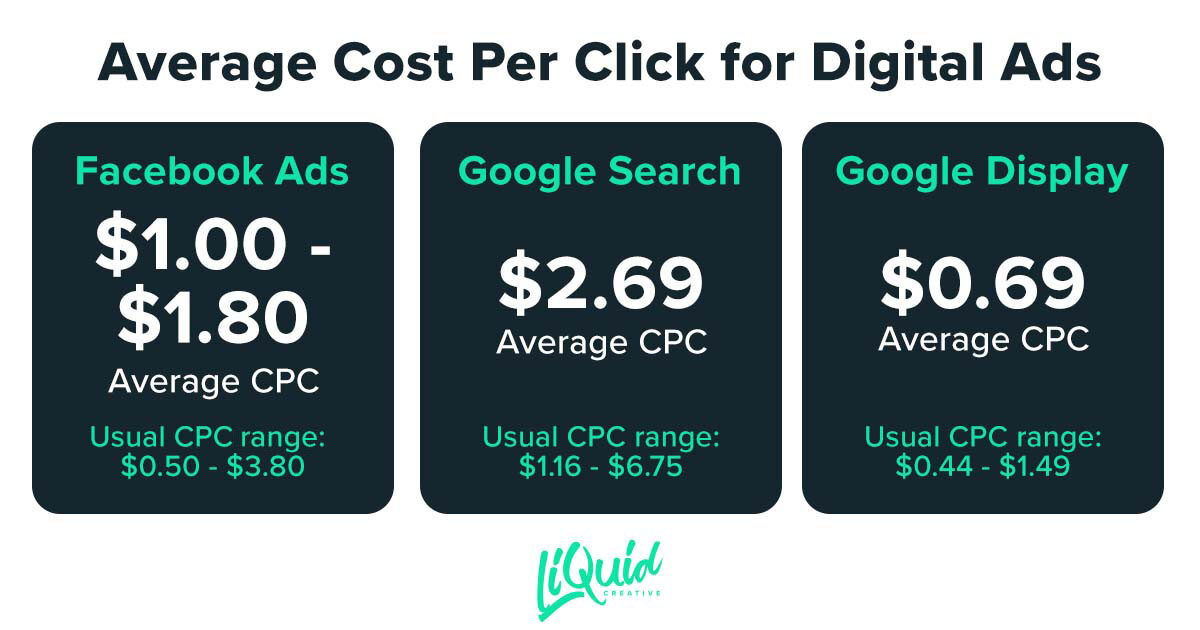
One of the most common metrics used to measure a digital ad campaign is cost per click (or CPC). This takes your ad spend and divides it by the number of times your ad was clicked to determine the cost of your ad. Your cost per click is how much you spent to get one person to visit your website one time.

There’s no fixed cost per click for digital ads. You can run the same campaign with the same budget and end up with a different CPC. Factors like your target audience, competitors, the time your ad appears, and more can influence your cost per click. Because you need to set your budget at the start of the campaign and you have no way to know how many people will click your ad, you won’t know your final cost per click until your ad campaign is running.

Based on past data, we have a general idea of how much digital advertising can cost. From our experience with digital advertising for our clients and reputable online sources, here’s an idea of what you can expect when running digital campaigns:

average-cost-per-click-digital-ads-5726246

Digital advertising costs change

Your campaign’s CPC will vary monthly, weekly, or even daily based on a number of factors. Because the cost is based on how many clicks you get, even 1 click changes your CPC. Since users decide whether to click on your ad or not, there’s no way to guarantee your CPC. When running a digital advertising campaign, you should monitor your cost per click and make changes accordingly. It’s best practice to tweak your ad at least monthly and compare results to find the winning combination of design and copy.


How much should I invest in digital ads?

If you’ve already run digital ads campaigns, you should already know what CPC you can expect from your Google or Facebook ads. If you’re new to digital advertising, use the average cost per click numbers above as a reference for your first campaign.

Knowing the average CPC of digital ads allows agencies and businesses to set realistic budgets for their intended results.

Let’s look at an example. A company is looking to make sales online through its website. After some analysis of their metrics, both online and off, they determine that an average of 1 in 50 product page visits converts to a sale. That sale will then net the business $100 in profit.

So we know that 50 clicks are equal to $100 in profit from 1 sale. We can divide that $100 by 50 to determine that each click can cost $2. If the CPC rises over $2.00, the business is not making a profit off of its digital advertising. In this case, the business needs to monitor their campaign, and their cost per click, to keep that number below $2.00.

If that same business continues running ads and finds that their average CPC is $1.00, they can estimate that investing $500 will net them about 500 clicks. That should lead to about 10 sales for an expected profit of $500.

This example doesn’t take into account the many factors that can affect your digital advertising. But it does demonstrate just how important monitoring your CPC is. To keep your CPC low, you need to create quality advertising aimed at your target audience. Business owners should also evaluate their ads regularly and adapt their future strategies accordingly.

factors-that-will-influence-your-digital-ad-campaign-5256052


Subscribe to our Newsletter
Monthly, easy-to-implement marketing tips to improve your website, social media, digital ads, cyber security, and more.

What influences the quality and final cost of a digital ad?

Not all ads are created equal. Digital advertising platforms like Facebook and Google evaluate the quality of your ads by considering different factors of your campaign. In turn, this can influence how often your ads are shown to viewers online. If your ad is deemed to be high quality, it’ll show more often with the same advertising budget, decreasing your cost per click.

So what makes an ad high quality? Here are some of the factors that come into play:

  • Quality of landing page: Most ads are only as good as the landing page they lead to. Facebook and Google rank landing page quality as one of the biggest factors in determining your ad’s quality score. To be considered high quality, your landing page needs to load quickly, be closely related to the content of your ad, and encourage users to take actions or browse your website.
  • Relevance and ad design: An ad should be both attractive and relevant. Both of these qualities will make it more likely for a user to be interested in, and therefore click, your ad. Communicate your message in an interesting, concise, and well-designed way. This will earn you clicks and let your ad show up more often for users.
  • The right target audience: Online audiences can be targeted using location, sex, age, interests, keywords, search intent, and more. Creating the correct target audience for your ad is key. Finding the right audience means your ad will be more relevant to them and get more clicks.
  • Size of target audience: If your target audience is too big, your ad spend could easily be diluted among too many individuals that aren’t as interested in your business. If your target audience is too small, you risk not reaching enough users and oversaturating the users you do reach. No one wants to see an ad that doesn’t apply to them or see the same ad over and over again.
  • Campaign objectives: Campaigns can have very different objectives: awareness, website traffic, leads, video views, and more. You can tell Facebook or Google what your objective is to have it correctly calculate your cost per intended action. The closer you get to making a profit, the higher your price per objective. In our previous example, the cost per click could go up to $2 while the cost per conversion (in this case, a sale) could be as high as $100.
  • The right keywords: Google ads rely heavily on keywords that users search for. Doing keyword research and evaluating your keyword performance during your campaign is very important. Some keywords are too expensive or too common to create cost-effective advertising. Adding specific keywords or long tail keywords (3 to 5 words together) can improve the effectiveness of your campaign.
  • Direct competitors: You’ll be competing with similar businesses for the same target audience or keywords. Finding out about their ad campaigns and understanding their strategy can help you understand how to stand out.
  • Indirect competitors: Your competitors aren’t the only ones trying to reach the same target audience. You also compete with different companies that don’t offer the same product or service as you, but that target the same target audience.
  • Seasonality: Many businesses have more popularity during a particular season. External seasonal factors have a direct impact on your campaign success as well. For example, November and December are more competitive (and expensive) because of Black Friday and Christmas. Industries like landscaping are more popular during warmer months when homeowners have to spend more time on their lawn. You’ll see keyword usage, and therefore how much you need to bid, change seasonally. Other issues – national news, global events, or even local trends – can affect keyword popularity and cost.
  • Not enough ad spend: Ads should generate enough results for Facebook and Google to intelligently understand your audience. As with a scientific study, you need a certain sample size to have accurate results. With too small of an ad spend and audience, these platforms can’t get a good read on what works or who they should be showing your ad to.
  • Too much ad spend: On the other hand, there is such a thing as too much ad spend. Especially if your target audience is smaller or very specific. If you have a large advertising budget, you should diversify by launching campaigns on different platforms and using different messaging to see what’s most effective. This way, you can spend your budget and know that your audience will see a few different ads for your business in a few different places, instead of uninterested viewers having you pop up on Google for keywords that are barely related.
  • Restricted categories: Most ad platforms have prohibited or restricted content. You have to be pretty careful when making ads related to categories like healthcare, political advertising, sexual content, alcohol, and gambling. Some categories, like housing, credit, and employment opportunities, are restricted to promote equal opportunity and avoid discrimination. For restricted categories, you can’t narrow your target audience based on age, sex, interests, or specific locations.
  • Expense of industry: Some business services are more expensive than others, which means most viewers will have to consider their purchase longer. Finances and insurance tend to have the highest CPC, while apparel and retail have the lowest. You can expect a lower cost per click if your industry doesn’t require a high level of trust, sells physical products, and has an affordable price per item. Meanwhile, keywords related to insurance (such as “auto insurance price quotes”) averaged a CPC of $54.91 CPC, and keywords related to loans (such as “consolidate graduate student loans”) averaged a CPC of $44.28 in 2020. These ads have to do a lot more work to get users to click – establishing their experience and trustworthiness while selling a specific service.
  • Type of industry: Some industries are just more interesting to consumers, giving them an advantage when it comes to getting engagement and clicks. Fashion and clothing ads are very likely to get more engagement than an industrial service.


Ready to jump into the world of digital advertising?

There is no simple answer when it comes to the cost of Google and Facebook ads. In fact, your cost per click is likely to change every day that your ad is running. As we’ve seen, getting the most profit from your digital ad campaign is determined by your cost per click, conversion, view, etc. To keep that cost down, ad quality and strategy can’t be beat.

That’s where we come into play. Liquid Creative is a full-service marketing agency experienced in launching digital advertising campaigns for businesses. Our team can create a digital campaign for your business based on our existing knowledge of what works. As your campaign runs, we’ll continue optimizing it for the best results and the most profit.

Contact us today to start your strategy-driven digital ad campaign on Facebook, Google, or anywhere else you’d like to be heard online!

Sources
https://www.wordstream.com/articles/most-expensive-keywords
https://www.webfx.com/social-media/how-much-does-it-cost-to-advertise-on-instagram.html
https://www.wordstream.com/blog/ws/2015/05/21/how-much-does-adwords-cost
https://www.oberlo.com/blog/facebook-advertising-cost
https://www.wordstream.com/blog/ws/2016/02/29/google-adwords-industry-benchmarks
https://revealbot.com/facebook-advertising-costs/cpc-cost-per-click

Results from Liquid’s clients ads

Strategic Social Media Always Wins!

The Strategy & Execution Behind Our FPRA Golden Image Award

strategic-social-media-always-win-3810698

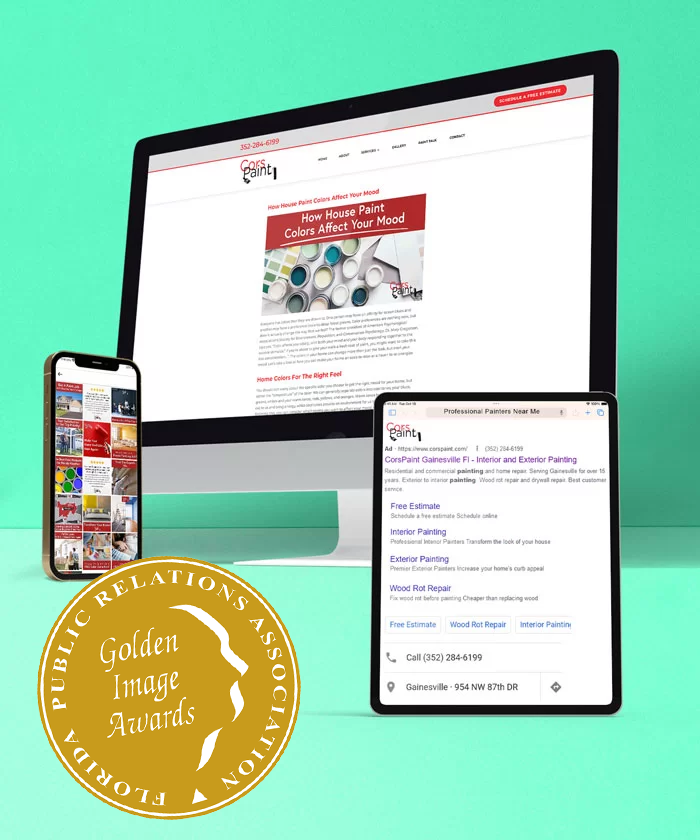
The team at Liquid Creative is thrilled and so, so honored to have received two awards at the Florida Public Relations Association’s 82nd Annual Conference. Our work for Red Door Homes of North Central Florida earned us FPRA’S 2021 Golden Image Award and Judges Award in the  digital tools of public relations division in the social media category. We’re proud of every campaign we create to further our clients’ goals, but it feels extra special to see our hard work recognized by FPRA!

“Winning this award was a complete team effort. It was incredible to see all the different elements of the work we do at Liquid Creative highlighted through the entry for this award. From the research – what we call ‘discovery’ – to the creative and implementation on social media, our team knocked it out of the park. The award is a testament to the strong partnership we’ve with built with our client at Red Door Homes.”

– Jen Pagh


What Is the Florida Public Relations Association?

The Florida Public Relations Association is a network for professionals in public relations throughout the state. FPRA provides opportunities for continued learning, chances to connect with others in the industry, and recognition in the form of state and local awards. At Liquid, Jen and Scott are members of FPRA, continuously adding to the public relations knowledge we use for our clients.


What Is the Golden Image Award?

FPRA’s Golden Image Award recognizes and promotes outstanding public relations work in our state! The competition contains 4 divisions that contain more specific “categories”, each with their own winner. Liquid’s award was in Division C, Digital Tools of Public Relations, in the Social Media category. The judges look for the best in every aspect of the campaign, from research to evaluation of results.


What Is the Judges Award?

The Judges Award focused on the return on investment a campaign achieves for the client. Similar to the Golden Image Award, entries for the Judges Award are divided into categories and expected to meet quality standards for research, planning, and process. Our social media campaign for Red Door Homes won both the Golden Image and Judges award for its category!
Our Social Media Campaign or Red Door Homes

Research

Starting with market research is essential to having a successful campaign strategy. For Red Door, we looked into everything from who our target audience should be to what market disruptions we should be on the lookout for. Here’s a brief summary of what we found before implementation began.

  • About 58% of Facebook users are 25-34 years old.
  • Millennials and Gen-Z home buyers were found to be most likely to be purchasing their first home.
  • Millennials are looking for affordable homes, with the highest percentage looking at homes in the $100,000 – $199,000 range.
  • A majority of millennials find owning a home to be a core part of the American dream.
  • COVID-19 wasn’t found to disrupt our local real estate market. In fact, the market was looking busier than normal.

This research helped us solidify a target market, make sure we were reaching them on the right channels, and confirm the timing of this campaign.

Facebook Posts

Take a look at the organic social media we created for Red Door Homes! This is a sampling of what we did over the last quarter of 2020, based on our research and strategy for this client. Liquid Creative handled this campaign in full – from topic selection to posting!

Facebook Posts

We also used paid Facebook advertising to reach our target audience. Here’s a look at some of the ads we created during this 3-month campaign!

Ready for Award-Winning Social Media?

We love being able to bring quality creative to our clients! Our all-inclusive social media services include everything from strategy to copywriting to design, so you can sit back and admire your profile. Contact us to hear more about how we can help you with all your marketing needs!

Get Found In Local Google Search Results!

Get Found In Local Google Search Results!

How to reach your audience with local search engine optimization

Your website’s ranking on Google’s search results is increasingly important. In many cases, this is how your business gets found. It’s as simple as this, when customers don’t see you in their search results, they’ll click on one of your competitors.To newer companies, small businesses, and those that don’t currently rank well on Google, competing with top-ranking websites can be intimidating. They have years of presence, tons of content, and huge budgets invested in website optimization. The hard truth is that outranking these companies isn’t practical for small businesses.

But the good news is that you don’t need to.

Google has gone increasingly “local” for its search results. Which means you don’t have to compare yourself to the big guys. To take advantage of search engines, you’ll need to create a local SEO (search engine optimization) strategy to boost your online presence and make you appear in front of your ideal target audience.

Here’s what you’ll need to know to get started:

How does Google work?
What is SEO?
What is local SEO?
Why is local SEO important for small businesses?
Important steps of a local SEO strategy
How to create a local SEO strategy


How does Google work?

Google is such a huge part of our lives that it’s become a verb. We use it daily, but have you ever asked yourself how Google selects your results? When you search for something in Google, the search engine uses various processes to rank millions of websites. In just fractions of a second, they present you with a list of websites that they think are the most likely answers to your query. These are called “organic results”, meaning not paid or sponsored. Google has over 200 of these searching and ranking factors, or algorithms, which determine the results you see.

So what is Google looking for in your website? The most common factors that make your website rank better on Google include:

  • Speed: Having a website that loads fast. This is especially important for the mobile version of your website.
  • Backlinks: Having other quality websites link to your website.
  • Content: Quality and quantity of content are equally important.
  • Keyword optimization: Use of the right combination of keywords in the right places on your website. Keyword optimization should be used in all the content on your site.
  • Metadata and related codes: There are many places to include content on a website that aren’t visible to a regular visitor. Meta titles, meta description, image alternate and link titles are all parts of your website code that can influence your search ranking.
  • Mobile friendly: Most of the traffic to websites comes from mobile devices, which introduce many limitations. Your website should give a great mobile experience.


What is SEO?

SEO stands for Search Engine Optimization, the continuous process of optimizing a website so it ranks better in Google and appears higher in search results. Successful SEO will increase the quality and quantity of traffic to your website.

When you hire an agency to develop your website, SEO should be a huge part of their process. From the planning stage to the development stage, the SEO strategy should be one of the biggest considerations for your website. After publishing, maintaining your website should include constantly updating and optimizing its content.


What is Local SEO?

Google search results are not the same for everyone. If two people search for the same keywords, they’ll get different results. Google uses algorithms to personalize and tailor your search results to your likes and needs. Your previous searches, the device you’re using, and your location will all influence your search results.

That’s right – location! Google has become adept at understanding when you’re looking for results from anywhere in the world and when you’re searching for something nearby. This is great news for small businesses! When a potential customer searches for businesses like yours, you have a fair shot at reaching them.

For example, if you google “how to make a pizza” you’ll get search results from the top recipe websites in the world. But if you google “order pizza” or “pizza near me”, Google understands that showing a search result for a pizzeria in New York would be of little value if you live in Ocala, Florida.

You don’t even need to write the word “pizza in Ocala”, because Google already knows that you’re in Ocala. It even knows which part of Ocala you’re in, especially if you’re searching on your phone. Your search results will include chain pizza restaurants as well as small local businesses located a few blocks away from you.

google-search-1-8748251

Why is local SEO important for small businesses?

Local SEO changes the playing field for small businesses. You won’t be competing with thousands of websites from across the world – just other businesses in your area.

This keeps local businesses from getting drowned out by national competition. You’ll have a fighting chance to show up in Google’s search results (including Google Maps). This lets you be visible to your target audience without breaking the bank on Google search ads.


Important steps of a Local SEO strategy

The fact that Google favors local results on its search doesn’t mean that your work is done. Businesses need a strong local SEO strategy to take advantage of Google’s local search results.

Take these steps to start improving your local SEO today!

  1. Optimize your website to include your location. Include location-related content in key places in your site copy and website code. Don’t just add your address to the footer on your website and call it a day – the more you mention your location, the better.
  2. Set up a Google Business Profile account. They uses to be called Google My Business. These accounts are key to improving your local positioning. This tool allows users to find you, understand what you do, and get in touch. These interactions, and adding to your online presence, can boost your ranking in search results and on Google Maps.
  3. Create local-based content. Include information related to your location in your blog posts, news, articles, tips, events, and more. Make sure to include the name of your city and other identifying keywords when you can.
  4. Build dedicated pages for each location. If you are serving different cities or counties, mention them on specific pages on your website. This often looks like separate contact pages for each area you service.
  5. Update your location on different local citation websites. There are hundreds of places where your business information can appear – Facebook, Yelp, Tripadvisor, and industry-specific business directories. Add your address and contact information to those that apply to your business – it’ll improve your local positioning online!


How to create a local SEO strategy

So now you understand why local SEO matters and how you can boost your ranking. Now how do you go about putting this information to work for your small business?

The best local SEO strategy includes everything we’ve talked about so far as well as “traditional” SEO strategies. This is not a checklist. You’ll need to keep updating and improving your online presence to stay on top.

  • Web maintenance: Keep your website content and code up to date. Check for errors and fix issues often. Include analyzing your keywords and viewing your search ranking often.
  • Content: Regularly create and update content on your website. Local content will get you far in local search results while using keywords makes your business appear with relevant search terms.
  • Google Business Profile: Keep your GBP up to date and use it to post images, videos, company updates, and more.
  • Local citation: Constantly update and push your information on location citation websites. Remember to check that the information is exactly the same everywhere.


Need a hand?

Not every business owner is ready to jump head-first into implementing a local SEO strategy. Especially since improving your rankings requires continuous updates, recurring website content, and a little bit of keyword research.

That’s where the team at Liquid Creative comes in! We can build you a website from scratch, optimize your current site, create social and GMB content, and maintain your presence with local SEO in mind. Contact us to get started!