facebook pixel

Facebook vs Google: Online Ad Strategy

lcs_blog_july2020-6145219


Your digital strategy should include some form of online advertising. There are 3.5 billion Google searches daily and Facebook has 1.45 billion users on the platform every day. Your target audience is online and looking for you, but getting in front of them might feel a little mystifying. To help take away some of the confusion, we have distinguished the advantages of advertising on Google and Facebook.

Audience Targeting

One huge advantage of online ads is ad targeting. You know how your Facebook feed seems to know that you need a new welcome mat and a guide to the best hiking trails in Costa Rica? That’s ad targeting. 

Google and Facebook collect data points on every user based on their interests, search history, demographic data, and interaction with other posts and ads. You can create audiences based on this data. This can include their employer, job title, marital status, whether or not they have kids, household income level, and more. These data points are drawn on to create audiences and show your ads to users that match key points of your ideal client. 

On Facebook, you can also create lookalike audiences. These audiences take similarities from a source audience and target ads to similar users while excluding users in your source audience. You can use lookalike audiences from multiple source audiences to create the audience for a single ad set, including visitors from your website and your Facebook page. 

Retargeting is another way that online ad platforms allow marketers to target audiences that are likely to buy. Facebook allows you to do this using Facebook Pixel. You can install the Pixel on your website or landing page and then use the data to show your ads to people who already visited your website. Google has its own version of the Pixel you can use to retargeting web vistors, the Remarketing Tag. 

Online ads are a key component of a well-rounded digital strategy. Both platforms allow you to meet people where they are in the buyer’s journey and provide them with access to your business’s offerings. 

Ad Formatting

Ad formatting is largely going to depend on your platform, your objective, and the ad’s copy (its wording) and graphics (its images) that will best highlight your brand. 

Facebook provides a great deal of flexibility to be creative with your text and visuals. There are limitations and guidelines, but you can use the combination of words and pictures that best demonstrate the value of your product or service. 

With Google AdWords, or Search Ads, you’re limited just to text. So you need to be able to communicate an impactful message with short copy and no visuals. If you think your message is better served with visual imagery, then Google Display Ads may be a better choice. Google display ads are shown on various partner websites through the Google Display Network

Choosing the right platform for your ads will depend largely on your business and on your digital marketing strategy. It may be wise to run test campaigns on Facebook and Google to determine which ad type works best for your business. 

Choosing Your Objective

Facebook allows you to select from a wide number of objectives for your ads. You can run campaigns based on where your audience is in their buyer’s journey. From awareness to consideration to conversion, Facebook has several options for ads in each phase. Because Google generates results based on what users are looking for, Search Ads only target conversions and maximize clicks to your website, however Google Display Ads are great for generating exposure to your brand. Facebook and Google Display are more appropriate if you are looking to spread awareness of your product. 

How Do I Know Which Platform is Right for My Business?


Once you’ve started considering the role ads play in your digital marketing strategy, you’ll get a clearer picture of what platform will work best for you. When you’ve determined your objective, target audience, and what you’re trying to achieve, reach out to us! Our team will recommend a strategy and budget that will help achieve your goals.  

Trend Spotting: Real World Take on the Digital Space

lcs_miniblog_june2020-1-8760307


1. Dramatic changes in PPC performance.

Covid-19 is causing our world to rapidly change. Unsurprisingly, ad performance is changing as a result. From March to May, cost per click (CPC) for Google ads has fallen dramatically while click-through rates (CTR) have risen. As things begin to open back up, the landscape is sure to shift again. The high conversion rates are likely a result of savvy marketers pivoting their messages to meet the needs of their target audience during the most restrictive lock-down phases. If you haven’t recently, it’s a good time to look at benchmarks in your industry and adjust your KPIs accordingly.

2. Chrome releases new metrics for evaluating web pages

Last month, the Chrome team released Core Web Vitals, which quantifies the user experience for your website. Going forward, metrics like loading speed, interactivity, and visual stability will be incorporated into search rankings. Page experience rankings will help users find relevant content that is easy to engage with. Top-quality content and on-page SEO are still going to factor in search rankings. These new metrics are there to help match users with the content they need in the best digital environment available.

3. Proactive marketers are gearing up for what comes next

Despite the economic uncertainty, we’re seeing an uptick in paid advertising. Things slowed down as businesses pulled their ad campaigns in the face of shutdowns and stay home orders. While unemployment is still high and the future is unclear, many marketers are starting to advertise again. Some businesses are newly advertising as they pivot from brick-and-mortar models. Other businesses are anticipating a surge in demand as we enter the new normal and are positioning themselves to be responsive. Online travel agencies were hard hit by the shutdown, but terms like “vacation” are on an uptrend as cabin-fever is setting in and states are lifting restrictions.

4. Move over live-tweets, Facebook Venue is coming soon

As Facebook moves to stay relevant as social media use changes, they have developed an app designed to make watching live events an interactive experience. While Venue users are watching a live broadcast event, they’ll be able to see commentary from hosts like journalists, athletes, or other experts related to the content. They will also be able to participate in polls and conversations that center around moments of the broadcast. These “Moments” will appear as notifications in the app and are created as the Venue host sees something discussion-worthy happening in the event. Facebook Venue will allow users to watch live events with expert commentary while connecting with other fans across the globe.


Be on top of the latest information in the digital marketing world. Each month, we’ll take a look at what’s changing in the industry and how it can help you move your strategy forward.

Influencer Marketing for Small Businesses

eaters-collective-129481-unsplash-600x400-9931950

How to Use Influencer Marketing

We’ve all witnessed the rise of influencer marketing over the years, and it’s projected to only keep getting bigger. Countless companies have implemented influencer marketing in their social media strategies, leveraging their chosen influencer’s connection with their target audience to cultivate new, positive relationships with their brand. Generating real results through influencer marketing, however, is contingent on carrying out an effective, purposeful strategy. 

What exactly is an influencer?

Generally speaking, an influencer is someone that inspires change. Such change can take form through emotion or action, and often starts a domino effect. Instagram has been deemed “the influencer platform,” and is where most influencer campaign ad dollars are spent.

As marketers continue to spend ad dollars to have their brands promoted by social media influencers, there have been changing trends in who constitutes as an influencer. More recently, marketers have come to find that most of the time it’s not the number of followers that matters most, but engagement rates.

In many situations, advertisers would rather use a micro-influencer—defined as a user with as few as 900 and as many as 500,000 followers—who is relatable to their audience and more engaged with them than a widely-followed, less accessible figure.

What can an influencer do for you?

If your goal is to increase your social media presence, consumer brand awareness, and overall sales, influencer marketing is a great tactic to consider adding to your social media strategy. (Don’t have a social media strategy yet? Learn how to make a content calendar!)

Marketers love influencers so much because influencers build their business by creating a relationship with their audience, and that audience trusts them.

Here are some quick stats that demonstrate the value of influencer marketing:

  • 70% of teens trust influencers more than traditional celebrities
  • 40% of users have purchased something because they saw an influencer use it on social media
  • The average ROI on an influencer campaign is $6.50 for every dollar spent

When using an influencer, writing the copy yourself or discussing the key points that will be included in their post allows you to share on-brand information with your audience, via a messenger that they already trust.

When an influencer shares their positive opinion of your brand, it builds interest among their followers. It’s key to include a call to action that directs the influencer’s followers to learn more about what they are promoting, allowing you to maximize conversions—not just brand awareness.

Selecting the right influencer

Choosing the right influencer for your business is an essential part of the process. For local small businesses, the first place to scout influencer talent is in the followers that have engaged with your business online. Customers that have geotagged their posts at your business, shared pictures of their experience, or liked or commented on your previous posts are great places to start your search. These customers are already engaged with your brand, and would be a natural partner in promoting it.

If that process seems to be a dead end, search your city name on Instagram. Searching Gainesville, Florida on Instagram brings up the top recent posts in the area, many relating to fitness, beauty, or fashion. You can browse these posts for users who seem like they appeal to your audience and would serve as a strong representative for your brand.

When sifting through potential influencer accounts, compare each user’s number of followers and their average likes per post. A user who has 3,000 followers, posts regularly, and generates a few thousand engagements per month is more valuable than a user who has 5,000 followers but doesn’t have an engaged audience.

The influencers that you choose will reflect your brand, and should pose minimal risks to your reputation. They should also promote a lifestyle or interest that relates to your industry or appeals to your target demographic. For example, a company selling workout gear should probably use a fitness influencer to reach people who are not only interested in fitness, but also trust that influencer for advice on the topic.

When selecting an influencer, remember:

  • They should have a strong following and strong engagement
  • Their followers should be members of your target audience
  • Their values should be in line with your brand’s values

Not sure how to define your brand? See if it’s time to rebrand your business.

How much does influencer marketing cost?

Some national brands dedicate large portions of their marketing budgets to influencer marketing. Small businesses may be deterred from influencer marketing due to its implied high financial requirements. In reality, compensating influencers isn’t always a large expenditure.

So, how much does influencer marketing cost? The truth is, it depends. According to digitalmarketing.org, an influencer with 2,000 to 10,000 Instagram followers charges $75 to $250 per post on average. On the opposite end of the spectrum, Kylie Jenner is famously reported to make $1 million per sponsored post. 

So you’ve debuted your influencers… now what?

Once your newly acquired influencers have posted their content, it is time to monitor how effective they really are. Key performance indicators (KPIs) vary across platforms, but it’s always about the numbers. Monitoring the number of likes and comments on the post, traffic to the page that you are promoting, and new followers for your business page are all basic ways to get an idea of the overall effectiveness of your influencer campaign.

Take Social Media to the Next Level with Liquid Creative

Serving Gainesville since 2007, our team brings fresh ideas and effective strategies to each of the social media accounts that we manage. We can help you implement a purposeful influencer marketing campaign that will maximize your ROI. Contact us to get started!

Social Media Strategy: How To Make A Content Calendar

lc_contentcalendargraphic_2018-1-8451590

Make A Content Calendar with Liquid Creative!

Keeping up with posting regular content across social media platforms can be challenging for any business owner or marketing manager. A content calendar is a useful tool to help plan what you will share and establish consistent messaging, ultimately allowing you to develop a social media strategy that will maximize post reach and engagement. Follow these 7 steps to make a content calendar that adds value to your brand.

Before we get started, you can download our content calendar template. You’ll see there are columns for date, time, purpose, copy, hashtags, links, graphics, and boosts, and that a different sheet is used for each platform.

[fusion_button link=”https://liquidcreativestudio.com/wp-content/uploads/2018/08/Liquid-Creative-Content-Calendar-Template.xlsx” title=”” target=”_blank” link_attributes=”” alignment=”center” modal=”” hide_on_mobile=”small-visibility,medium-visibility,large-visibility” class=”” id=”” color=”custom” button_gradient_top_color=”” button_gradient_bottom_color=”” button_gradient_top_color_hover=”” button_gradient_bottom_color_hover=”” accent_color=”” accent_hover_color=”” type=”” bevel_color=”” border_width=”” size=”large” stretch=”default” shape=”” icon=”” icon_position=”left” icon_divider=”no” animation_type=”” animation_direction=”left” animation_speed=”0.3″ animation_offset=””]Download the Liquid Creative Content Calendar Template[/fusion_button]


1. Select Relevant Social Media Platforms

Creating business accounts on social media platforms that are relevant to your industry will enable you to reach your target audience, but creating profiles on irrelevant platforms will waste your time and hurt your brand. So, how do you choose which platforms to focus your energy on? The answer– as with many things in marketing– is research. Before you make a content calendar, you should find out where your customers are online and the best way to get there. A good place to start is seeing what your competitors are up to.

2. Plan Timely Posts

Creating timely posts is critical for both engagement and conversions. It’s important to have a strategy behind the dates, times, and frequency of your posts. You can use platform insights to find out the days of the week and times of day that your audience is most likely to be active. Check out any competitors’ accounts, and think carefully about what you need to communicate to customers about your business. For instance, if you hold events or have timely sales, you should begin advertising over social media weeks in advance, or longer. Then, you should continue posting about the event as it approaches. Make sure that you are sending out friendly reminders, but not clogging followers’ newsfeeds.
Some ways to tell you’re oversharing:

  • You’re losing followers
  • Engagement is declining
  • You’re posting for the sake of posting

3. Establish Clear Purpose

So, how do you avoid posting for the sake of posting? There should be a clear purpose behind each of your social media posts. Try to write posts with different purposes behind them to keep your content calendar diverse. The more purposes you can incorporate into one concise post, the better.

Here are some ideas to get you started:

  • Provide a Timely Update: Announce an event, sale, opening of a new location, or other timely update
  • Drive Website Traffic: Advertise a product or service with the goal of driving traffic to a specific webpage
  • Educate Your Audience: Teach your audience about a product’s application or an aspect of your business services
  • Demonstrate Expertise: Show your followers you’re an expert in your field with relevant and helpful information, such as how-to videos or, let’s see, an insightful blog post, perhaps? 😀
  • Spark Engagement: Different platforms have different algorithms, and engaging users will help your content show up in their newsfeeds (tip: Instagram story polls earn easy engagement)
  • Showcase Company Culture: Connect with followers and potential employees by providing a peek into your company’s unique culture

These are just a few basic ideas to get you started on your social media strategy. And remember, you can write your posts with more than one purpose in mind as long as you can keep the messages concise. The purpose of the post will determine where it links to, or if you shouldn’t have a link at all. If you’re posting to wish your customers a happy holiday, that isn’t the time to link to your website. Use a variety of purposes to prevent engagement from declining, and avoid planning many “sales-y” posts in a row when you make a content calendar.

4. Write Engaging Copy for Each Platform

Every post that you create should fit into your brand’s story. If you’re finding it hard to envision what exactly your brand’s story is, it might be time for you to rebrand. The copy you write should have a tone consistent with your brand, and its message should be driven by the purpose you have determined for the post.

You should also write different copy for different platforms. While Twitter is the only widely used platform with a character limit, there are other factors to consider. For instance, Instagram does not link to external pages other than on promoted posts and bios, and is a largely visual online community. Your copy for Instagram would be more concise and possibly more playful than your copy for Facebook, and would likely have a different call to action. When you make a content calendar, do some research so that you’re aware of effective call to action messages for the different platforms. Effective call to actions are a critical part of any marketing campaign, and should be used in your social media strategy.

5. Use Strategic Hashtags

Utilizing hashtags is the best way for companies to extend their organic reach on social media platforms, gain followers, and earn engagement. You should keep a list of hashtags relevant to your industry and location, and use these as they are relevant to your posts. For instance, if you are a hairdresser in Gainesville, Florida, you can browse Instagram to find the hashtags local Gainesville salons and residents are using to showcase their styles. Try adding hashtags as a comment on your post, instead of as a caption, to avoid cluttering the copy.

Here are some hashtags relevant to the Gainesville, Florida area:

  • #theswamp
  • #bestofgainesville
  • #gnv
  • #gainesvillebusiness
  • #gainesville
  • #gainesvillefl
  • #gainesvilleflorida

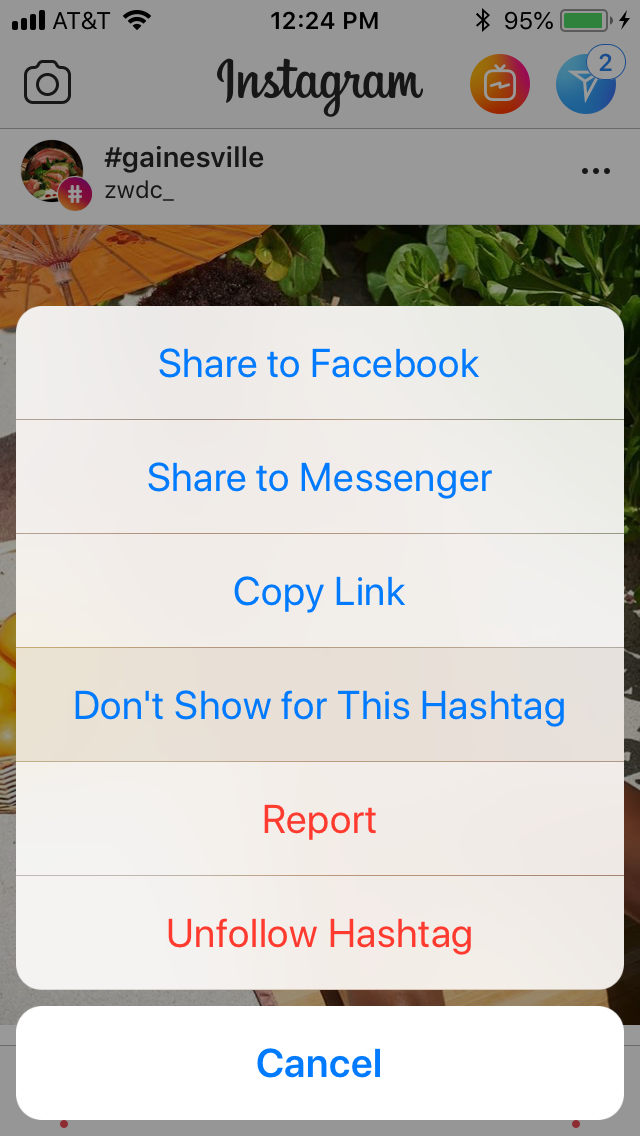
Be sure to avoid using the same hashtags over and over again unless they match the post, otherwise users may request not to see your content for a specific hashtag, which could cause the algorithm to lower your reach.

Here, you can see that a user created a post and used the hashtag #Gainesville. Liquid Creative follows the Gainesville hashtag, so it showed up in our newsfeed. If we don’t think this post is particularly relevant to Gainesville, we can hit the “Don’t Show for This Hashtag” button.

img_1904-5488720


When a user does this, a nice message thanking them for their feedback appears in their newsfeed in place of the post.

img_1905-8302178

This feedback is used to block this account from appearing in my newsfeed for the hashtag, and likely lowers the reach for the post on that hashtag across the entire platform. Taking the time to research relevant, high traffic hashtags pays off. Learn how to increase your Instagram engagement with this quick read.

6. Post High Quality Graphics

Posting high quality, branded graphics to your account is not only important for consistency and professionalism, but also for communicating a clear message to your audience. Color alone increases brand recognition by 80%, and graphics are often able to deliver a more digestible and engaging message than copy by itself. This is especially critical on social media, where shares can greatly increase both your audience and the credibility of delivery. In general, you are more inclined to be interested in and trust a post that was shared by your cousin than a post that was shared by a company. It’s easy to measure your impressions with digital marketing, making high quality graphics an even more worthwhile investment.

One third of online time is spent watching video. It’s officially time to recognize the trend and invest in quality video content. Try to include different mediums when you make a content calendar, such as infographics, videos, and GIFs.

7. Promote Your Posts

As social media platforms have become more saturated with content, they’ve tweaked their algorithms to show users the most relevant posts. Most platforms now prioritize content from personal accounts over business accounts, causing reduced organic reach and engagement.

Facebook’s prioritization has been part of a big PR push. Zuckerberg announced in January 2018 that the algorithm would begin showing users more content from “friends, family, and groups.” This decline in organic reach on Facebook and across platforms has inspired companies to invest more in paid digital marketing efforts.

Social media platforms offer extensive data tools that enable advertisers to effectively reach their target audience. With a paid digital marketing campaign, you can target a “lookalike” audience of customers who are similar to those that already like your page. This shows your post to the audience most likely to take interest in your product or service. Incorporate promoted posts when you make a content calendar for the best return on your time spent developing a social media strategy.

Make A Content Calendar

Now that you know the basics behind social media strategy, it’s time to make a content calendar! Use the columns to plan out the date and time, purpose, copy, hashtags, links, graphics, and boosts of your posts, and add to the columns if there’s something else you want to include. If you’ll be running different ad types, add a column to keep track of that as well. We recommend using Excel or Google Sheets, and using a different sheet for each social media platform.

We’ll Handle Your Social Media Strategy

We’re the experts on Gainesville social media strategy. We’ve been managing social media for Gainesville businesses since 2011, and use our local knowledge to create engaging content that appeals to Alachua County residents. Focus on running your business, let us handle your social media strategy. Give Liquid Creative a call at (352) 600-5050, or visit our website to learn more about our social media management, digital marketing, branding, graphic design, and website development services.

Increase Instagram Engagement in 5 Steps

Adapt to the Algorithm, Grow Your Instagram Presence

Instagram’s rapid growth has cemented its place as the cornerstone of a solid social media strategy, but has also caused the platform’s algorithm to quickly change. Instagram reached 800 million active monthly users in September 2017, a 100 million increase since that April. As a result, the newsfeed has evolved with the growth in user base as the company works to improve the user experience. 

So, how do we adapt to this changing algorithm?

Instagram is evolving with its growth by generating news feeds that contain the content that the algorithm deems most applicable to the user. This is largely measured through engagement– which poses a problem for businesses that are new to the platform or have few followers. Basically, the more engagement you already have, the easier it is to get more because your posts will show up in more news feeds. Fortunately, there are several tactics to get your posts appearing in more news feeds that don’t require gaining new followers, though you will definitely pick some up along the way.

Increasing Engagement– Even with Few Followers

Try these 5 simple strategies to boost your Instagram engagement, even if you don’t have many followers.

1. Share Instagram Stories

While you should have a solid content strategy for your Instagram posts, Instagram story views are a great way to indicate that your followers are interested in your content, and will increase your chances of your posts showing up in their newsfeed. Use the polling feature to further take advantage of this opportunity while receiving your customers’ valuable opinions!

2. Post When Followers Are Online

Some of the top factors the Instagram algorithm considers are the number of likes and comments received and how you engage with users. When you have few followers, it’s especially important to monitor overall activity metrics and post at the times that they are most active.

3. Engage With Users

Many business owners are surprised to learn that the algorithm also accounts for their reaction time to users’ comments and direct messages. Make sure that you are consistently monitoring the platform and remaining responsive to capitalize on your increased engagement.

4. Craft the Perfect Captions

Crafting the right caption is key to connecting with your audience and driving engagement. Make sure that your captions are concise and are written in the tone of your brand. 

5. Use Relevant Hashtags

Hashtags will expand the reach of your posts and connect you with new users. They’re even more critical now that users can follow hashtags. If they follow the hashtag that you use, your post can show up in their news feed regardless of whether they actually follow you.

Here are some hashtags that are relevant to the Gainesville, Florida area:

  • #theswamp
  • #bestofgainesville
  • #gnv
  • #gainesvillebusiness
  • #gainesville
  • #gainesvillefl
  • #gainesvilleflorida

Grow Your Instagram

If you combine these tips with a strong content strategy, you will be well on your way to growing your Instagram presence, and gaining more brand recognition.

Need help managing your social media strategy? Liquid Creative is a full-service marketing agency in Gainesville, Florida with the local insight to effectively target residents of Gainesville and the greater Florida area. Call Liquid Creative today at (352) 600-5050, or visit our website to learn more about our social media packages!


How Important is Social Media for the Growth of Your Business?

Over recent years, we have all been witness to the explosive growth and increased usage image2-7823560of social media platforms. Facebook, for example, started as a hub for college students in 2004 and is now a social media network on which nearly 2 billion active users communicate and interact with friends, family, community, and brands. Talk about influential! Let’s take a look at just four of the many advantages and reasons why effectively branding your business on social media is so vital.

Brand Awareness

The simplest way to break down the big idea behind social media branding is to say that the more people see your profile or logo on their timelines, the most likely they will remember your business, identify a need, and convert into a customer. It’s about more than just posting content about your business, it’s also about posting content that is relevant to your viewers. Ask yourself “what are my target audience’s interests?” When content is valuable and relevant to your audience, they are more likely to share it with their network which increases your reach to a new audience that could potentially convert into a customer.

Customer Insight

With the power of social media analytics, you are able to directly see the demographics of the audience your content is reaching. Another way to gain customer insight is through social media listening. What are people saying about your brand? About your industry? Social media listening can be done by tracking posts that you are mentioned in and monitoring hashtags.

Social media interaction is also a way to have more open, faster communication with customers. When customers reach out to you via social media it humanizes your brand and adds value to their user experience.

Increased Web Traffic

The term SEO is everywhere these days, but many business owners still don’t understand how much social media can potentially help boost your rankings. Sharing of content that links to your website (such as blogs, community pages, and landing pages) not only increases web traffic, but as people share your links the more Google is likely to improve your ranking.

Targeted Content

Social media is among the most cost effective marketing tools available. With the growth of social media platforms such as Facebook, Instagram, and Twitter, they have all integrated paid content options that allow you to directly target your intended audience by age, gender, location, interests, and much more!

Start engaging with your audience and expanding your brand’s reach via social media. The team at is here to help get you started and guide you toward your goal of effectively reaching the masses! (352) 600-5050