facebook pixel

Making New Year’s Resolutions Stick: Practical Tips for Personal and Professional Success

Making New Year's Resolutions Stick

New Year’s resolutions are a beloved tradition, but let’s be real—many of us struggle to keep them. By February, the gym might feel like a distant memory, and those grand plans to save more or stress less? They somehow get lost in the shuffle of life.

But here’s the thing: Following through on resolutions isn’t about willpower alone. It’s about being practical, intentional, and strategic in how you set yourself up for success.

Here are some tried-and-true methods to help you keep your personal and professional resolutions in 2025.

Start With Small, Specific Goals

Ever notice how resolutions like “get fit” or “be happier” sound inspiring but rarely lead to action? That’s because they’re too vague. Instead of aiming to “get fit,” try, “I’ll go for a 30-minute walk three times a week.” Breaking your resolution into smaller, specific goals makes it feel less overwhelming and easier to tackle.

When you’re realistic about what you can achieve, it’s easier to build momentum. You don’t have to climb the whole mountain in January; just focus on taking the first few steps.

Write Your Resolution Down and Keep It Visible

There’s something powerful about putting pen to paper. Write your resolution somewhere you’ll see it daily—a sticky note on your laptop, a reminder on your phone, or a note under a fridge magnet. Seeing it regularly keeps it fresh in your mind and helps you stay focused.

Better yet, frame your resolution in positive language. Instead of saying, “Stop wasting money,” try, “Save $20 each week.” A positive spin can make your goal feel more exciting and achievable.

Use the Buddy System to Accomplish More

Accountability is a game-changer. Share your resolution with a friend or colleague who can cheer you on—or better yet, join you! If your goal is to exercise more, find a workout buddy. If you’re aiming to eat healthier, swap recipes and meal ideas.

Having someone to share the journey with makes it more fun and less lonely. Plus, knowing someone else is rooting for you (or checking in) can be the motivation you need to keep going.

Plan for Setbacks in Life and Business

Nobody’s perfect. Life gets busy, old habits sneak back in, and sometimes we just don’t feel like sticking to our plans. That’s okay.

Instead of letting a slip-up derail you, treat it as part of the process. Missed a week at the gym? Don’t give up—just pick up where you left off. Planning for setbacks ahead of time makes them feel less like failures and more like temporary detours.

Striving for excellence motivates you

Stack Your Habits to Achieve Your Goals

One of the easiest ways to keep a resolution is to attach it to something you already do. This is called “habit stacking,” and it works like magic.

For example, if your resolution is to drink more water, pair it with your morning coffee routine. Fill a glass of water while your coffee brews and drink it before your first sip of caffeine. Over time, the new habit will feel just as automatic as the old one.

Track Your Progress Throughout the Year

Seeing progress is incredibly motivating. Whether it’s a fitness app, a savings tracker, or a simple checklist, find a way to monitor your journey.

Celebrating small wins along the way—like hitting a weekly target or sticking to your goal for a month—can give you a sense of accomplishment and keep you excited about the bigger picture.

Reward Yourself for Any Achievement

Speaking of celebration, don’t forget to reward yourself! Resolutions shouldn’t feel like punishment; they should feel like opportunities to improve your life.

When you hit a milestone, treat yourself to something that aligns with your goal. For instance, if your resolution is to save money, maybe your reward is a small splurge on something you’ve been eyeing (just don’t break the bank and set yourself back). If it’s fitness-related, how about a new pair of workout shoes?

Check the Data, Revisit the Goal, and Adjust Metrics

Life changes, and so can your resolutions. If you set a goal in January but realize in March that it’s no longer serving you, it’s okay to adjust.

Think of your resolution as a living thing—something you can refine as you learn more about what works for you. Staying flexible doesn’t mean giving up; it means being smart about what’s realistic and beneficial.

Keep Your Focus on the “Why”

Why did you choose this resolution in the first place? Keeping the deeper purpose in mind can help you stay committed when motivation wanes.

For example, if your goal is to quit smoking, your “why” might be to have more energy for your kids or improve your longterm health. When the going gets tough, reconnecting with your “why” can reignite your determination.

All organizations start with why.


Every step forward—no matter how small—is something to be proud of.

Resolutions are about growth, not flawless execution. Even if you stumble, you’re still moving in the right direction, and that’s what matters most.

However, resolutions aren’t just for personal growth. The first quarter of the year is a crucial time for businesses. 

It’s the period when teams are energized to hit the ground running, and strategic initiatives begin to take shape. 


Meaningful KPIs

Common Q1 Goals for Businesses and Actionable Tips for Achieving Them

Many businesses set ambitious goals in Q1 to build momentum for the rest of the year. We’ve listed some of the most common goals to get you started or to see how your business stacks up. 

  • Revenue Growth and Sales Targets: Businesses often aim to start the year strong by increasing revenue or hitting specific sales benchmarks.
  • Customer Acquisition and Retention: Whether it’s bringing in new clients or retaining existing ones, businesses prioritize growing their customer base.
  • Budget and Financial Planning: Q1 is the time to finalize annual budgets and establish cost control measures to ensure financial health throughout the year.
  • Employee Training and Development: Many companies focus on upskilling their teams or onboarding new hires effectively during this period.
  • Operational Efficiency: Streamlining workflows, implementing new technologies, or improving processes is often a key focus to set the tone for productivity.
  • Marketing Campaign Launches: Fresh marketing initiatives—such as product launches, rebranding, or seasonal campaigns—often take center stage in Q1. Liquid Creative is the perfect partner to help you achieve your marketing goals!
  • Compliance and Reporting: For businesses with fiscal years that align with the calendar year, Q1 is a time for audits, tax preparation, and ensuring regulatory compliance.
A Practical Q1 Goal in action

Prioritizing Your Goals Is a KEY Part of Reaching Them

It’s tempting to tackle everything at once, but spreading resources too thin can lead to mediocre results. Identify two or three top priorities for Q1 and allocate resources accordingly.

First, set S.M.A.R.T. goals to ensure that Q1 objectives are Specific, Measurable, Achievable, Relevant, and Time-bound. For example, instead of saying, “Increase sales,” try “Increase Q1 sales by 10% compared to the previous quarter through targeted email campaigns.” Liquid Creative is the perfect partner for email campaigns!

Large goals can feel overwhelming. Break them into smaller, actionable tasks with clear deadlines. For instance, achieving a sales target might involve weekly call quotas, monthly performance reviews, and daily team check-ins.

Frequent check-ins allow teams to track progress, address roadblocks, and celebrate small wins. Agile practices like sprint planning or project reviews can keep everyone aligned.

Speaking of teamwork and alignment, each goal should have a designated “owner” responsible for driving it forward. Clear accountability ensures tasks don’t fall through the cracks and allows for better tracking of progress.

Use historical data to set realistic targets and monitor progress. For example, if customer acquisition is a goal, analyze which channels performed best in the past and double down on those strategies.

Unexpected challenges or market shifts may arise, so it’s crucial to be open to adjustments. Regularly revisit goals and pivot strategies as needed to stay on track.

Recognize and reward achievements, even if they’re incremental. Celebrating milestones boosts morale and keeps the team motivated to push toward the next target.

How Can Liquid Help You Reach Your Goals?

Q1 can set the tone for a productive and profitable year. By setting clear goals, staying organized, and maintaining flexibility, businesses can not only achieve their objectives but also build a strong foundation for success.

This year, let’s ditch the all-or-nothing mindset and focus on progress, positivity, and practical strategies. With these tips in your back pocket, 2025 could be the year your resolutions finally stick. You’ve got this!

If you want help setting goals for your company, identifying and articulating KPIs, or support to help you achieve your business resolutions, contact us today. Take an important step in the right direction: Make Liquid Creative your marketing partner for 2025! 

How to Handle Holidays — At Work and Online

Holidays - At Work and Online

Summary: Whether it’s federal and company holidays or religious and industry-related observances, here’s a guide on how to handle holidays in the office and online.

If you don’t think holidays are important to your employees, think again. Research shows that workers want paid vacation (76% of those surveyed), paid sick time (74%), and paid holidays (74%). That can add up to a lot of time off.

How do you decide which holidays to observe? How do you manage the workload while employees are out? Which holidays should the company acknowledge on social media, and how? How do the holidays affect your client relations and account management? Read this blog to find answers to these questions and more.

Graphic showing different holiday stats.

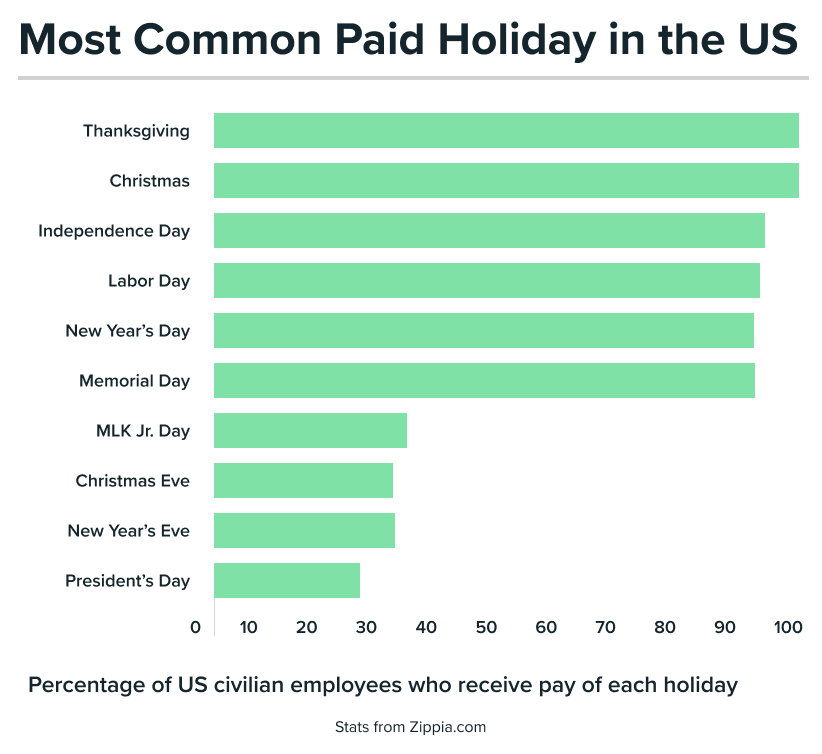
What Are the Most Common Paid Holidays in the United States?

Federal holidays in the United States are government-mandated and provide federal employees with a paid day off, whereas non-federal holidays like Valentine’s Day and Halloween are not government-recognized, and observance by businesses is optional. While federal employees are guaranteed time off on federal holidays, most employers are not obligated to offer paid leave for any holidays but may do so as an employee benefit.

The Fair Labor Standards Act (FLSA) does not require private-sector employers to provide paid or unpaid time off for holidays, though many choose to do so to boost employee morale and retention. Exceptions exist, such as in Rhode Island, where employees working on Sundays and holidays must be paid time and a half. Additionally, some employers may be obligated to offer paid holiday leave under collective bargaining agreements.

Keep in mind that state and local governments and private businesses might call these holidays by other names, but our list follows the names designated in federal law. (Federal employees in the Washington, DC, area also receive Inauguration Day as paid leave for each fourth year; this policy started in 1965.) Typically, there are only 11 federal holidays each year.

What are the Federal Holidays for 2025?

  1. New Year’s Day — Wednesday, January 1
  2. Birthday of Martin Luther King, Jr. — Monday, January 20
  3. Washington’s Birthday — Monday, February 17
  4. Memorial Day — Monday, May 26
  5. Juneteenth National Independence Day — Thursday, June 19
  6. Independence Day — Friday, July 4
  7. Labor Day — Monday, September 1
  8. Columbus Day — Monday, October 13
  9. Veterans Day — Tuesday, November 11
  10. Thanksgiving Day — Thursday, November 27
  11. Christmas Day — Thursday, December 25

Bar graph showing most common paid holidays in the US.

We’re nearing what some people call the Holiday Quarter because traditional Q4s include a lot of personal PTO as well as federal days off like Thanksgiving and Christmas. These dates are known for their sales (hello! Black Friday? Cyber Monday?) almost as much as their original cultural significance.

               Read More:How the Holidays Affect Your Digital Campaigns

From a marketing standpoint, Black Friday, Cyber Monday, and the Christmas shopping seasons can increase campaign costs and change user behavior. Be ready for the holidays to affect your business and your bottom line.

How to Handle Religious Holidays at a Secular Company

Handling religious holidays at a secular company requires a thoughtful and inclusive approach to respect diverse beliefs while maintaining a neutral work environment.

Here are some best practices to consider:

  • Establish a Clear Policy: Create a clear, written policy on time off for religious holidays that is communicated to all employees. The policy should outline how requests for time off will be handled, ensuring fairness and consistency.
  • Offer Flexible Leave Options: Allow employees to use personal, vacation, or floating holidays for religious observances. This flexibility enables employees to take time off for their specific religious holidays without requiring special treatment.
  • Accommodate Requests When Possible: Make reasonable efforts to accommodate requests for time off for religious holidays, as required by law, unless doing so would cause undue hardship to the business.
  • Foster an Inclusive Environment: Encourage a workplace culture where employees feel comfortable discussing their religious needs with HR or administration.
  • Avoid Scheduling Conflicts: Be mindful when scheduling important meetings, deadlines, or company events, avoiding dates that coincide with major religious holidays whenever possible.
  • Consider a Floating Holiday System: Offering floating holidays gives employees the flexibility to observe religious or cultural holidays that are important to them, ensuring they feel respected and valued.
  • Maintain a Secular Tone: Ensure that company-wide events and communications remain neutral and inclusive, avoiding favoritism toward any particular religion.

By implementing these practices, a secular company can respect the diverse religious needs of its employees while maintaining a fair and inclusive workplace.

How to Handle Holidays Online Without Getting Canceled

Recognizing holidays on social media can be a valuable way for companies to engage with their audience, but it should be approached carefully to avoid backlash or potential missteps.

Of course, you want to be social (it is social media, after all), which means a degree of personality and candid content. But you also don’t want your company to be boycotted for putting their foot in it.

Here are a few social media best practices to keep in mind:

  • Stay True to Your Brand: Focus on holidays that resonate with your brand identity and mission. For example, a brand focused on sustainability might highlight Earth Day, while a medical company might recognize awareness dates that emphasize health and wellbeing.
  • Be Inclusive and Sensitive: When recognizing holidays, be mindful of cultural and religious sensitivities. Ensure your messaging is respectful and avoid making assumptions about how people celebrate. Inclusivity can help prevent backlash and demonstrate your brand’s commitment to all potential customers.
  • Research and Plan Carefully: Take the time to understand the significance of each holiday before posting. Avoid superficial or generic messages that could be seen as insincere (at best) or tokenism (at worst). Planning content well in advance allows for careful consideration and review.
  • Engage Authentically: If your company chooses to recognize holidays, do so authentically. Engaging in performative recognition can backfire. If a holiday doesn’t align with your brand, it’s okay not to comment on it.
  • Monitor Responses and Adapt: Pay attention to how your audience reacts to holiday posts. Use feedback to adjust your approach in the future, being willing to learn from mistakes and improve.
  • Consider Opting Out: If your brand’s position or audience makes recognizing certain holidays potentially controversial, it may be wise to opt out. Silence can sometimes be the best option if the risks outweigh the benefits.

Whether a company should recognize holidays on the company’s social platforms depends on its understanding of its audience and brand identity. For example, if you sell Christmas ornaments, posting about the Christmas holiday is a must. If you work for an international secular non-profit, referencing the winter season would be a safer (and kinder) approach.

Even beyond the topic of holidays, it’s true: Thoughtful, well-researched, and inclusive content can enhance brand engagement, while poorly executed posts can lead to backlash.

How Many “National Days” Do Americans Observe?

Beyond federal holidays and common religious observances, we now have other “national days” that are often posted about on social media and sometimes celebrated in office, though employees are rarely awarded time off for these occasions.

Some people think we’ve taken the concept of “national days” too far. And, they might be right. There are more than 1,500 “national days” each year, along with a barrage of accompanying hashtags aimed at boosting corporate marketing goals.

For example of how companies monetize these “days,” creating them for advertising and marketing purposes, think about the current trend (and pressure) to ask a date to high school prom in the most spectacular way possible. Did you know that “National Promposal Day” (March 11 each year) was founded by Men’s Wearhouse to make sure high schoolers are asking their date to prom with plenty of time to get tux rentals. Did you know that “National Little Red Wagon Day” was created by Radio Flyer?

In 2024, March 28 alone contained 10 “days” to recognize (and that doesn’t even cover the awareness “weeks” and “months”), including “National Black Forest Cake Day,” “National Something on a Stick Day,” “National Weed Appreciation Day,” and “Respect Your Cat Day.”

Cat looking through a hole in a piece of paper.

Most of these days come with their own hashtag and promo kits, but trying to recognize all of them on your social media would be a mistake. Not to mention require three full-time jobs.

It’s good marketing practice to be aware of federal holidays, religious observances, and even speciality days/weeks/months that are related to your industry. This awareness will help you determine your company holidays, respect employee traditions and cultures, and create a social media calendar with posts that reach your target audience without exploiting them.

Best Practices for Handling Holidays in House

Regardless of the dates you decide to observe as a company, remember this three-step guide:

  1. Create
  2. Communicate
  3. Plan

Create a calendar and clearly communicate it to all employees so the entire team is aware in advance of the paid holidays that will be observed.

Plan ahead for these holidays since “observing” them means employees will not be working those days. This includes making sure your staff has met deadlines in advance, delivered any projects to clients that would be due in their absence, and communicated with their clients or customers about the closure.

It’s a good idea to have a company-wide protocol regarding out-of-office email statements (with emergency contact information) for individual employees to use for holidays and PTO.

Remember that your clients may also take an extended OOO break around federal holidays, so external communication and planning are also paramount.

Finally, it’s smart to have a back-up plan in place in case an emergency occurs (like an entire website or online ordering system goes down) while people are on leave.

Best Marketing Agencies in Town

If you need more advice on this topic or other business matters, let us know. You have objectives. We have solutions.

Plus, when it comes to social media management and marketing best practices, we’re the cat’s meow (once a cat gets stuck in your head, it’s hard to get it out).

At Liquid Creative, we work with clients all over the state and across the country. We’re an in-house team of Operations Managers, Account Managers, Strategists, Writers, Designers, and more — all working together to bring your ideas to life.

If you need assistance to boost your brand and sales, we can help. Contact us today to see what we can do for you.

Blogs, huh, what are they good for? Absolutely something.

Blogs, huh, what are they good for? Absolutely something.

Summary: How do blogs help companies boost visibility and sales? Through thought leadership and brand trust. Hire a marketing agency to write yours. 

A company maintaining a monthly blog typically aims to achieve several key objectives:

  • Brand Awareness and Visibility
  • SEO (Search Engine Optimization)
  • Customer Engagement and Education
  • Lead Generation and Conversion
  • Community Building
  • Thought Leadership and Expertise Demonstration

“Thought Leadership” is a buzzword that refers to the practice of a company or individual positioning themselves as an authority in their industry or area of expertise. Thought leaders are recognized for their deep knowledge, innovative ideas, and ability to influence other people’s thinking. Sometimes, these folks are also called “SMEs” or Subject Matter Experts. It’s kind of like an Influencer, except instead of using their fame or clout (or stunning good looks) to attract customers, they use their extensive — and successful — experience in their field. 

They often produce content such as articles, white papers, webinars, and blog posts that provide valuable insights, forecast trends, and address pressing issues in their industry or market sector. The goal of thought leadership is to establish credibility, build trust, and influence public perception, thereby creating a competitive advantage for the company or individual.

As a full-service marketing agency, we are often hired to write blogs for companies that have nothing to do with marketing. How do we provide helpful information on various topics related to their industry? A ton (and we do mean a ton) of research — on the industry, the trends, the topic, the company, the product, you get the idea. We even conduct interviews with company employees and members of their target audience. 

You can see why it would take a long time for the company itself to do this work, and how hiring a marketing agency saves them time and money — and lets them get back to focusing on their own work so they can achieve the specific KPIs of their particular role in the company.

               Read More:Ultimate List of Blogging Statistics and Facts

Marketing Blogs Are Different, and Here’s Why

With marketing, and marketing blogs, it’s a little bit different. If we spent our entire blog time (every month) talking about marketing tactics, who is our target audience?

Three Possible Categories:

  1. People who are going to market their own business? 
  2. People who might google to ask a question like “what are digital ads” because they’re looking to hire someone to help them generate leads?
  3. People who have already hired Liquid Creative and are already clients of ours? 

People in Category #3 don’t need marketing tips because they’ve hired us to handle their marketing for them. Using a blog to showcase our extensive marketing prowess doesn’t benefit them. They might need tips on how to work around a break in the manufacturing supply chain or roof material trends for the next year so they can plan their orders and keep a better eye on their budget. 

We write for companies all the time. We research their audience, their product, their differentiators, search words their potential customers might use when looking for a company — and then we write a blog that will attract those potential clients and give them something of value that will help them in their current business. By doing this, month in and month out, we build trust in that brand and people start turning to them for answers to all sorts of questions — and, yes, more often than not, it eventually generates a lead that converts to a sale and creates a loyal customer. 

For example, if we write a blog for a real estate company, we might talk about different kinds of seller and buyer agreements and what to look for before hiring an agent. If we write a blog for an insurance company, we might talk about recent federal and state legislation that will impact policies and premiums.

What Makes Sense for a Liquid Creative Blog?

When it comes to writing original content to house on our own website, only Category #2 makes sense for us as a marketing agency. So we plan to spend about half our time writing about topics that will answer common search questions for people and businesses looking to hire a marketing agency. But unless you’re planning to do your own marketing (Category #1), our writing every blog about marketing jargon or tips or strategies or services, doesn’t do much to help you. TBH, it doesn’t do much to help us either — although we might build trust in our brand and establish ourselves as Thought Leaders in the marketing industry, we’re certainly not attracting leads or making sales. And we have our own budget to keep an eye on. 👀

The other half of our blogs, though — including next month’s blog — are going to provide information that will help leaders and teams of nearly any company in any industry. That way, current Liquid clients and orgs that have their own marketing in hand will still have a reason to read our blogs. There’s still value to be added, and that’s our goal! 

But first. 

When to Hire a Marketing Agency and When to Do Your Own Marketing in House

For starters, maybe your company is large enough to house a marketing department. Maybe your company is also wealthy enough to afford to hire for every role a typical marketing agency offers. Good for them. We mean it

Second, small businesses with one location and limited local reach often don’t need the volume of content and design work that requires a salaried position. By employing freelance writers and designers, businesses can pay by blog post or creative project instead. (We still don’t recommend asking Bob in accounting to write a blog in his spare time. Unless Bob is really, really good at writing blogs.) 

But for the small businesses wanting to grow or the medium-to-large business without an in-house team, hiring a professional marketing agency is going to get you the best work for your money. 

Best work in what? Well…

  • Social media content creation
  • Social media management
  • Logo concepts
  • Website build
  • Newsletter creation
  • Voiceover talent
  • Email management
  • Data management & reporting
  • Proofreading
  • PPC campaign management
  • Research & writing 
  • Blogging
  • Competitive & industry research
  • Web maintenance
  • Scriptwriting
  • Presentation preparation
  • Conference submissions
  • Company branding
  • Guest blog outreach
  • Blog comment moderation
  • Video production
  • Email design
  • Podcasting
  • Graphic design
  • Video editing
  • Press release writing
  • Public relations
  • SEO optimization
  • SEO site audit
  • Photography
  • Photo editing
  • Editorial calendar management
  • Infographic creation
  • And more!
You get the idea. Agencies do a lot, and the best agencies do it well. Some companies are large enough to have their own in-house marketing team, even if that’s only one or two people. But let’s say you don’t have official marketing roles at your business — you just have someone who can write and someone who knows their way around Canva or Photoshop. Can you save money by having those folks cover your marketing and advertising needs? Sure! Will the decision pay off in the long run? Probably not.

Graphic of a table list of potential pros & cons of outsourcing your marketing

Best Marketing Agencies in Town

We wouldn’t leave you hanging without answering the question posed in this blog’s title: Blogs, huh, what are they good for? Absolutely something.

The something? Blogging can make a huge difference in how your website performs in search engines as long as you’re also utilizing Search Engine Optimization (SEO). By optimizing your blogs, more people will know your name, visit your site and make a purchase. At Liquid Creative, our SEO experts maximize your visibility and help get you on the first page of Google. Optimizing your blogs is one way we do it.

If you know you want to hire a marketing agency, we’re kinda partial to Liquid Creative. Based in Gainesville, Florida, we work with clients all over the state and across the country. That big list of work you read a minute ago? We do that. 

At Liquid, we are an in-house team of Operations Managers, Account Managers, Strategists, Writers, Designers, and more — all working together to bring your ideas to life.

If you need marketing assistance to boost your brand and sales, we can help. Contact us today to see what we can do for you.

Want to Know How to Build Brand Awareness, Generate Leads, and Convert Sales?

Want to Know How to Build Brand Awareness, Generate Leads, and Convert Sales?

he short answer is easy: Have a quality product or service, sell it at a reasonable price, clearly communicate what you have to offer, provide excellent customer service — and marketing, marketing, marketing.

The marketing funnel helps you tailor your content to your customer’s journey. In this instance, “content” means several different things — all put together like puzzle pieces that fit to make a cohesive whole. The “whole” is your message. The “pieces” (or content) include the type of marketing tactic (AKA tool, platform, medium) used. These can be a website, a social media post, an email campaign, and so forth. Other pieces of “content” include words and design elements.

An industry-standard B2B marketing funnel looks similar to a sales funnel. However, just as customers face different goals or problems at different points in their user journey, so must your content have different goals at each stage in the funnel.


b2b content marketing funnel


What Kind of Marketing Does Your Company Need?

The answer for you depends on your short and long term business goals, your company’s current position in the market, as well as who your target audience is.

When it comes to advertising, however, it’s usually recommended to strike a balance between lead generation ads and brand awareness ads, as they are the two most important pillars of a campaign.

If you’re a new or new-ish company, a sleek, user-friendly website that clearly communicates who you are, what you do, and why consumers should choose you is Priority One. After that, awareness campaigns are crucial to introduce your product and lodge your brand in your audience’s mind. These are visual campaigns that include graphics, animations, and videos that run as social media ads, Google Display ads, and video ads.

Nine Marketing Tasks to Get You Started

  1. Develop a content marketing strategy that engages your audience and drives conversions.
  2. Use targeted social media platforms to increase brand visibility and interact with potential customers.
  3. Improving your website’s search engine optimization to attract organic traffic and boost search engine rankings.
  4. Create effective email campaigns that keep your audience engaged and drive sales.
  5. Identify and collaborate with local co-brands to expand your reach and build credibility with your target audience.
  6. Use Google Analytics to track and analyze your website traffic and marketing campaigns.
  7. Design and optimize landing pages that capture leads and drive conversions.
  8. Create compelling video content and leverage video marketing to engage customers and promote your products.
  9. Run a cost-effective PPC campaign on platforms like Google Ads and Facebook Ads to maximize your ROI.

This list of nine tasks provides a brief overview of various digital marketing tactics that can help businesses build brand awareness, generate leads, and convert sales.


Marketing Metrics and How to Make Them Work for You

In the past, the sales funnel was a straightforward process that started with marketing and ended with the customer’s purchase. Today, that model has been replaced with a more dynamic model that requires adaptive marketing as consumer trends, digital platforms, and the economic landscape shift.

old world marketing

Now, there’s every opportunity to try new approaches, expand to new channels, and A/B test your tactics. But you won’t know how a tactic is working until you begin monitoring the results. Pay attention to what the analytics tell you, and use the additional information to continue optimizing your marketing strategy.

To evaluate your current marketing campaign, ask the following questions:

  • Are we meeting our KPIs (Key Performance Indicators)?
  • Are campaigns working as intended?
  • Which campaigns are the most successful? Why?
  • Which campaigns aren’t working as we hoped? Why?
  • What did we learn from the most successful campaigns?
  • How can we improve less successful campaigns?

With your evaluations complete, it’s time to take action. Take the opportunity to boost or extend your successful campaigns. For less effective campaigns, decide whether to pause or hit “start over.” You can use your newfound knowledge to improve the tactic or refocus your budget on what’s already working.

The key to adaptive marketing is acting based on the metrics you gather — whether it’s optimizing a campaign or pivoting to an entirely new direction.

What Now? Hire an Experienced Professional Agency.

Liquid Creative can do all nine of the tasks we mentioned — and more!

with services ranging from branding to social media management . . . and everything in between.

Some of the services we provide include:

  • Branding & Logo Design
  • Website Design, Development, Refresh
  • Digital Advertising
  • Social Media Management
  • SEO, Online Ranking, Local Search
  • Copywriting & Graphic Design
  • Photography and Video Production

At Liquid Creative, we are an inhouse team of Operations Managers, Account Managers, Strategists, Writers, Designers, and more — all working together to bring your ideas to life.

If you need marketing assistance to boost your brand and sales, Liquid Creative can help. Contact us today to plan next steps and make the magic happen!


Where You DON’T Want Your Digital Ads To Appear

Where You DON’T Want Your Digital Ads To Appear

Marketing is all about sharing the right message to the right audience at the right time. With sophisticated audience algorithms and more tools than traditional advertising, digital advertising gives you more tools than ever before to do just that. Google, Facebook, and other digital ads have plenty of options for defining your target audience and controlling where your ads are seen.

Being specific about who sees your ads and where is an increasingly important step in making the most of your digital ad campaigns. Where your ads don’t appear is just as important as where they do. Including negative keywords, excluding websites, and choosing content exclusions can safeguard your brand image while making your digital ads more effective.

Why Does Narrowing Your Digital Ad Placements Matter?

In short, showing your ads to the people who are most likely to click on them optimizes your digital ad spend.

The price of digital ads is usually measured in cost-per-click, or CPC. The CPC of your ad is determined by taking your total budget and dividing it by the number of users who clicked your ad.

When you specify your audience and ad placements, you improve the percentage of people who click on your ad after seeing it. This encourages Google, Facebook, and other digital ad platforms to promote your ad by proving it’s valuable and interesting. The end result is an efficient ad spend that earns you more quality leads.


Don’t show your ad in searches for unrelated keywords

When advertising on search engines such as Google and Bing, you may end up paying to appear next to keywords that don’t relate to your business. For example, if you owned a house painting business, you may unintentionally appear in a search for “Painting classes at home”.

Whenever that happens, your campaign becomes less effective. It’s best to avoid it altogether by specifying negative keywords.

What Are Negative Keywords?

A keyword is a search term that you’d like your ad to appear on. A negative keyword is just the opposite – a search term you never want your ads to be associated with.
In the example above, “painting” and “home” would be great keywords to use for a house painter. Using the negative keywords “classes” and “class” would clear up any confusion. Since it’s highly unlikely someone searching for those terms would click your ads, excluding them makes your ad campaign more efficient.

How to check for negative keywords

Even Though you can foresee some negative keywords and add them to your campaign from the start, it’s highly unlikely that someone can think of all the unrelated keywords a person could use next to your keywords.
Once your search campaigns are running, constantly monitor the actual search terms people use that triggered your ad to show up. Here you can find all the unrelated keywords and start adding them to the negative keywords list.


Don’t show your ad next to questionable content

To maintain your brand image, it’s important to ensure that your ads don’t appear next to questionable content. This may include mature content, adult language, controversial videos, political opinion pieces, and more.

Excluding this content from your ad placements can help you maintain professionalism and avoid unintentional associations with negative messaging.

What Are Content Exclusions?

Google and Facebook allow you to choose what content you don’t want your ads to appear next to. On Google, there are three main categories of content exclusions:

  • Digital content labels: This acts as a rating system, from general audiences to mature audiences. Choose which sections of the scale you don’t want associated with your brand. It’s often safest to exclude the most mature category, DL-MA, and content that hasn’t yet been labeled.
  • Sensitive content: Most of the sensitive content labels are beneficial to avoid. These include topics such as profanity, tragedy, and controversial social issues.
  • Content type: You can also choose not to have your ads placed within videos, in YouTube live streams, in games, and more. These are a bit more up to debate, so take the time to review what’s best for your type of business.

Facebook calls their version Content Type Exclusions. You can choose topics such as religious & spiritual, gaming, politics, and news to exclude from your ad placements. In addition, you have the option to remove your ads from live streams, where content is more difficult to monitor and rate.


Don’t show your ads in low quality placements

Your Google Ads, mostly display ads, show up in Google’s Display Network (GDN). This network includes websites, apps, YouTube channels and more, which are called placements. But not all placements are created equal. They range from highly regarded news channels to low quality websites.

We mentioned that you can create content exclusion. For example, you don’t want your ads to show up on kids or gaming YouTube channels. But content exclusion is not perfect and your ad could still show up in placements that you don’t desire.

How to check for low quality placements

Similar to checking for negative keywords, you can check for places your ads appeared in the “where ads showed” Google Ads tab. If you don’t like one of these placements, select them and ask Google Ads to exclude them from your campaign.


Don’t show your ads to certain audiences

Defining your target audience is a huge step in setting up strategic digital ads. It’s helpful to target your ads based on location, age, interests, and more to make sure your ads are reaching the right people. This step should also include choosing what audiences you don’t want to see your ads.

Targeting just the right people can improve your cost-per-click and overall results. Experimenting with ad audience exclusions is a great way to make sure you aren’t spending money advertising to current customers or incompatible audiences.

What Are Ad Audience Exclusions?

Both Google and Facebook have options for removing audience members based on certain characteristics.

  • Current customers: Based on your ad content and objective, advertising to current customers may not suit your goals. For example, brand awareness ads are better served to audiences who haven’t visited your website before.
  • Current employees: Your employees are already aware and interested in your business, so it’s best to exclude them from your audience.
  • Conflicting interests: By excluding users with certain interests from your audience, you can reduce negative feedback and better optimize your ad spend. For example, a local thrift store may choose not to target audiences interested in luxury brands when advertising a sale. Finding a conflicting interest may take some creative thinking, but this step can really narrow your ad audience!
  • Users who have interacted with your brand: If someone has messaged, liked, followers, or otherwise interacted with your account, they’re likely already aware of your brand. Excluding these people, as well as users who may appear in remarketing audiences, can assist with brand awareness objectives.


Looking To Learn More About Digital Marketing?

Liquid Creative has guided many businesses through successful Facebook, Google, and Instagram ad campaigns. With experience with local to national brands, we bring strategy and amazing creative work to every one of our clients.

If you’re a small business owner looking to learn about conducting your own digital marketing campaigns, check out Liquid GROW! This is a new digital marketing course to teach you the basics of Google, Facebook, and other digital ads. If you’d prefer a full-service marketing partner to run your digital marketing from strategy to results, contact us today!

Why and How to Use Video in Your Marketing — with Examples

Why and How to Use Video in Your Marketing — with Examples

In today’s digital landscape, video marketing has become essential to business marketing strategy. With the rise of social media and the increasing popularity of online video platforms like YouTube and TikTok, video has become one of the most effective ways to engage with customers and build brand awareness.

In this blog post, we explain why businesses should invest in marketing videos, the different kinds of marketing videos and how they can be used, and how to create effective marketing videos. We’ll also offer some cool examples for you to check out.


What Is Video Marketing?

Generally speaking, “video marketing” is pretty self-explanatory, right? You use videos to promote and market your brand, products, and/or services. Specifically, this can include anything from product demos and customer testimonials to explainer videos and behind-the-scenes footage of a project. The goal of video marketing is to engage and educate your audience, build brand awareness, and ultimately drive sales.


Why Your Business Should Invest in Marketing Videos

There are many compelling reasons why businesses should invest in marketing videos. According to different studies 1, 2, 3 on both consumers and video marketers, some benefits of video marketing are:

  • Improve Brand Awareness: 95% of marketers say marketing videos help them increase brand awareness
  • Influences Buying decisions: 89% of people say watching a video has convinced them to buy a product or service, and they say it’s the #1 way they discover a brand they later buy from
  • Return on Investment: 92% of marketers say marketing videos got them good ROI.
  • People are expecting it: 91% of people say they are expecting more online videos from the brands they follow.
  • Helps with SEO: 87% of marketers say video has made users stay on their website longer, which is a good SEO indicator


Examples of Different Kinds of Marketing Videos

There are many different types of marketing videos businesses can create. Here are some of the most common, with links to examples you can watch for ideas:

Brand Videos

Showcase a brand’s personality, values, and mission to its target audience. Brand videos typically feature a mix of live-action footage, animation, graphics, and voice-over narration to create an emotional connection with the viewer. They help businesses establish a strong brand identity, increase brand awareness, and improve customer engagement and loyalty. Check out this brief brand video from Straight Line Construction.

Brand video for Straight Line Construction.

Customer Testimonials

Feature satisfied customers sharing their positive experiences with your product or service, which can help build trust with potential customers and encourage newbies to make a purchase.

Client testimonial and case study for Hurd Construction.

Explainer Videos & How-To Videos

Explain complex concepts or processes in a clear and concise manner. With step-by-step visuals to accompany audio or written instructions, viewers are more likely to understand exactly what you’re explaining because they can watch the demonstration. Demo videos are great to teach customers how to use your product or service, which also helps reduce customer support calls and improves customer experience.

Video tutorial for City of Newberry.

YouTube Video Ads

Short video clips that businesses can use to promote their products or services on the world’s biggest video streaming platform. Your video ads can appear before or during a regular content video and are typically skippable after a few seconds. With YouTube’s targeting options, you can reach potential customers who are more likely to be interested in your products or services.

YouTube Ad for Straight Line Construction.

Social Media Ads

Short, engaging videos can be used as ads on social media platforms such as Facebook and Instagram. These can help increase brand awareness and user engagement, plus drive traffic to your website. Similar to YouTube ads, social media ads have very specific targeting capabilities. At Liquid, we’ve found social media ads to be very helpful.

Social media video ad for Liquid Creative.

Animated Videos

Animation is used to tell a story or convey a message. This method can make a heavy topic more palatable for the viewer to watch; it is also useful when you don’t have access to live actors. Often used to explain complex concepts, showcase a product or service, or entertain and engage an audience, one of the main benefits of animated videos is that they are highly versatile and can be used in a variety of settings, from social media to website landing pages. We created an animated video to announce the upcoming show season for the Ocala Civic Theatre, and animation was a great vehicle for the content we were showcasing.

Season reveal 22/23 for the Ocala Civic Theater.

Walkthrough Videos

Tutorials that guide viewers through a product, service, process, or even a location. They can be used to educate customers, increase product understanding and adoption, and improve customer satisfaction. Walkthrough videos can also be used to highlight product features and benefits that may not be immediately apparent in print.

Walk Through Video for Grove Street Games.

Team Intros

Short videos that introduce a business’s team members, showcasing their personalities, roles, and contributions to the company. These videos humanize a brand, build trust and credibility with customers, and create a sense of connection and community. By putting a face to the name, team members become more relatable and approachable, helping to build stronger relationships with customers.

Team Intro Video for Pat Myers Electric.
Other forms of video marketing include webinars, vlogs, behind-the-scenes footage, live streaming, and more.

Subscribe to our Newsletter
Monthly, easy-to-implement marketing tips to improve your website, social media, digital ads, cyber security, and more.

But How Do I Create a Marketing Video?

We’re glad you asked. Now that you know what you need, let’s talk about how to do it.

First, it’s important to understand that video marketing goes beyond creating one-off videos. Brands should integrate video across all their platforms, all the time.

One business that does this well is Straight Line Construction (you saw several of their video examples featured above). Liquid Creative has been working for Straight Line for two years, and we are constantly creating new video content for them—brand videos, team videos, video ads, client testimonials, and social media videos. Because of the effectiveness of this holistic video campaign, we received the Grand Image Award 2022 in the marketing video category.

We know that creating an effective marketing video can be a daunting task. Some of the reasons for not starting doing video campaigns that we’ve heard from business owners include time constraints, they don’t know where to start, lack of resources, lack of expertise, fear of being on camera, or they aren’t sure if the return will be worth the investment.

But creating a video doesn’t have to be difficult. Here are some steps to ensure your video is engaging, memorable, and achieves your marketing goals:

  1. Decide who is filming your video: Are you doing it in-house (with your team and resources), or are you hiring a video production agency?
  2. Determine your goal: Before creating your video, it’s important to know what you want to achieve. Do you want to increase sales, improve brand awareness, or educate your audience? This will help you create a video that is focused on achieving that goal.
  3. Know your audience: Understanding your target audience is key to creating a video that resonates with them. Consider their age, gender, interests, and “pain points.” Pain points include the questions they are asking, the products they need, and the problems they need to solve. Taking the time to discover this information will help you create content that speaks directly to them.
  4. Craft your message: Once you know your goal and audience, it’s time to craft your message. Your message should be clear, concise, and focused on the benefits your users will receive if they choose your product or service.
  5. Plan your visuals: The visuals of your video are just as important as the message. Plan out what you want your audience to see and how you want to present it. This could include graphics, animations, or live-action footage.
  6. Write your script: Your script should be engaging, memorable, and short. Well, brief enough to capture and hold interest—and just long enough to cover the main idea. Most sources suggest keeping the word count around 60–75 for a 30-second video. You don’t want to speed read because you will lose key inflections and emphasis, and your audience won’t understand or remember much of what you said. According to JL Recording Studios, three words per second is an acceptable pace for video script writing. Consider using storytelling techniques to make your video more memorable. Everyone likes a good story, whether it’s funny, nostalgic, or sentimental. And it’s always smart to end with a Call-to-Action of some kind, even if it’s just to get in touch (with your contact info included).
  7. Choose your music & sound effects: Music and sound effects can make or break a video. Choose music that complements your message and adds to the emotional impact of the video. If the script covers a serious subject, an upbeat, happy tune will undermine your message.
  8. Test & refine: Once you’ve created your video, test it with a focus group or a small sample of your target audience. Use their feedback to refine your video and make it even more effective before you publish the video on your platforms.

By now you know that video marketing is a powerful tool to help businesses achieve their marketing goals. With engaging, memorable videos, businesses can increase brand awareness, generate more leads, and improve customer engagement. With the right strategy and tactics, any company can use video marketing to their advantage.

If you haven’t done so already, it’s time to start incorporating video into your digital marketing strategy and see (pun intended) the results for yourself. If you’re interested in working with an award-winning video production agency, be sure to contact us so we can discuss your projects.


  1. The State of Video Marketing 2023. Wyzowl.
  2. The Video Marketing Playbook. Trends & Tips to Create a Video Strategy in 2023. HubSpot.
  3. Digital 2022 Global Overview Report. WeAreSocial.

What Are Users Really Doing on Your Website?

What Are Users Really Doing on Your Website?

You’ve just launched a new website for your business. Now, all that’s left to do is sit back and wait for the leads to come in, right?

Not exactly.

To get the most out of your website, you need to pay attention to how people are using it. Seeing which blogs people are reading, what buttons people are clicking, and even what terms people are searching for will tell you a lot about how you can convert a new customer.

In this blog, we’ll dive into what website analytics you should keep your eye on, what insights they provide about your website, and how to make tweaks to improve your conversion rate.

Must-have Website Analytics

There are many different tools to view your website’s metrics. Although Google Analytics 4 is the most popular one, you can measure analytics with tools ranging from WordPress plugins like MonsterInsights or as part of CRM platforms like HubSpot. With these tools you get an inside look at how visitors interact with your website. While there are a ton of metrics to track, these are the most important ones for understanding how your website is performing.

Sessions

Sessions can be thought of as periods of time when someone browsed your website. From the moment someone lands on your website to the moment they navigate away counts as 1 session, as long as they remain active.

Website sessions are a good metric for understanding how busy your website is. It gives you an understanding of how many times your website is being browsed, not just how many people are visiting. This metric is helpful for understanding how your website is performing in a given time period. Check your website sessions monthly to see if any trends emerge.

Pageviews

Pageviews are the number of times that an individual page was viewed. Anytime someone opens up a page, they add another pageview to your total.

This metric is very helpful for understanding which pages of your website are popular. By seeing which pages are getting the most pageviews, you can understand what information people are looking for, which blog topics perform the best, and which pages might be difficult to find. Use these insights to lean into what works and improve navigation to pages with less views.

Most Visited Pages

The most-visited pages show you what content your audience is most interested in.

This metric can show you which services people are checking out, which of your blogs are creating the most traffic, and what pages people are looking at before they decide to contact you. A high-traffic page presents an opportunity: focus on how to impress your users and encourage action within your most-visited pages.

Session Duration

Session duration indicates how long someone is staying on your website after they arrive.

A shorter session duration could mean that people aren’t finding the content they’re looking for on your website. To improve your website’s session duration, add valuable information and don’t use “clickbait” in your ads or social media. In general, your session duration shows how long you’re keeping your visitor’s attention.

Location

Location shows you the geographic location of your website visitors.

For most businesses, traffic from outside the U.S. should be excluded from analytics results. For local or regional businesses, you may want to see what percentage of your traffic is within your service area. If you’re seeing a high percentage from outside your coverage area, you may need to adjust your marketing or more clearly state your location on your website.

Source

A source refers to where the website traffic came from. This includes if the traffic is direct, organic or paid. If you set up a way to track your campaigns (for example, using UTM codes), you can see which specific campaign brought traffic to your website. This means that you can know if the traffic source was from your social media post, a Google Search Ad, or your YouTube video ad.

This is one of our favorite metrics here at Liquid Creative. If you tie it to the conversion metric (explained in the next paragraph), you can measure which campaign brought your desired conversions and be able to evaluate the performance of each campaign.

✉ Subscribe to our Newsletter
Monthly, easy-to-implement marketing tips to improve your website, social media, digital ads, cyber security, and more.

Conversions Metrics

Some of the most common goals for business websites are leads and sales. When a visitor takes action on your website, it’s considered a conversion. Many service-oriented businesses rely on their website to generate leads, including form fills, email inquiries, and phone calls. E-commerce businesses are more likely to look for online sales.

Unlike the metrics explained before, conversions are metrics that you have to create yourself, based on your goals.

Here are three of the most common and useful conversions:

Form Fills

Form fills refer to submissions to any form on your website. These forms allow users to do things like ask general questions, requesting a quote or a free estimate, ask for a call back, and more.

Most businesses are interested in the quantity of leads they can generate through form fills. However, you should also be aware of the quality. Take note of how visitors are interacting with your form. What fields are they skipping? What common themes do you see? Making your form as fast and easy as possible is likely to increase the number of form fills you’ll receive. Optimize the experience by reducing required fields, adding dropdowns, and being clear about the information you’re requesting.

Phone Clicks

A phone click event activates whenever a user clicks on a phone number on your website. If you coded your website correctly, that click should generate a call. Although this works mostly on mobile, and only if the user clicks on the link (not if they call directly), it’s still an important conversion to evaluate.

Sales

If you are running an eCommerce website, tracking a sale conversion is probably the most important conversion metric of all.

How is your user interacting with your website

So, you designed your website following all the recommended web design trends. Now, which metrics can help you find out how the user interacts with your design? All the metrics we’ve talked about so far may give you valuable information about your user and the actions they take in your website, but they don’t show you how the users interact with each page. Are they liking the design? Are they interacting with it in the way you planned? Are they clicking in places you can’t track with other metrics?

To solve those questions you can use the following tools:

Heatmaps

Heatmaps show how users move and click around on your website.

A heatmap is a great way to evaluate user experience and interest. Pay attention to where people are clicking and where they aren’t. For least-clicked areas, make sure your language is clear and users know what to expect after they click. On the other hand, your most-clicked areas show you new opportunities for expanding your website content.

Session Recordings

Session recordings are actual video recordings of your user interacting with your website. You’ll get a screen video capture of important information like how they scroll, where they move their mouse, in what places they spend more time, and how they go back and forth in between pages.
For privacy reasons, you will not know who the person is or access important information they fill in forms, like phone numbers or credit cards.

Analyze, Strategize, and Optimize

Improving your website is a continuous process. Updating your website, adding content, and improving usability will both improve your SEO and convert more visitors into customers.

Using the metrics above to analyze your website, strategizing ways to improve it, and implementing those changes should be a cyclical process. At Liquid Creative, we develop stunning business websites while always strategizing our next step. We can improve your existing website with intentional updates, improve your SEO with monthly blogs, or even create a personality-filled site from scratch.

Our website team prioritizes strategy and usability to earn you the most calls and clicks. Learn more about how we can help you impress and convert your website visitors: Contact us today!

Agency or In-House Marketing Team: Which Is Better for Business?

Agency or In-House Marketing Team: Which Is Better for Business?

Any company that wants to grow needs to take their marketing efforts seriously. Successful marketing is both comprehensive and consistent, which is why it yields desired results. In this article, we share important pros and cons of various levels of marketing services to help you determine what kind of marketing is best for your business goals.

For this article, we only consider strategic, ongoing marketing efforts. This means we won’t be addressing one-off projects that might require the hiring of a web designer or photographer. In the end, this blog can help you decide whether to hire a marketing agency, create an in-house marketing team, or utilize a hybrid model.

Partnering With a Marketing Agency

Any type of business will benefit from hiring a marketing agency, but it’s especially beneficial for small and medium businesses, who may not be positioned to hire a professional in-house team with sufficient marketing experience and expertise.

Pros of Working with a Marketing Agency

Expertise: Marketing agencies have a breadth of knowledge in multiple areas of marketing. Because of their vast knowledge and skill set, they are able to create professional campaigns with goals, objectives, strategies, and tactics. Furthermore, they are then able to plan, implement, and monitor those campaigns.

Experience:

From years of creating multiple campaigns for various clients in different industries, marketing agencies have irreplaceable practical experience in what works and what doesn’t. Therefore, agencies are better suited to anticipate problems and troubleshoot solutions (which can also save the client’s reputation, not to mention time and money).

Flexibility:

Having a multidisciplinary team with talents in different areas allows an agency to offer the marketing mix that produces nearly any deliverable and achieves any outcome . . . for any kind of company.

Scalability:

If you plan to grow your business, but you are not yet where you want to be, an agency can easily scale your marketing efforts to match your budget and then increase your campaigns when it’s the right time to do so.

Advanced Tools and Technology:

Agencies have access to specialized tools that optimize every part of your marketing campaign with no additional cost to you. These tools include everything from design software and analytic programs to state-of-the-art computers, video production, and print capabilities.

Access to Resources and Providers:

Agencies constantly work with external companies in advertising and media relations. These connections will get you better and faster deals than what you could have negotiated on your own.


Cons of Working with a Marketing Agency

Finding the Right Fit:

Partnering with an agency is a big commitment. It may be a hard decision to choose one over the other, and choosing the wrong agency could generate lasting problems for your brand. We recommend you take your time, do your research (ask previous clients about their experience), and make an informed decision.

Potential Conflicts of Interest:

A marketing agency you prefer might already have contracts to work with competing companies in your industry. It’s a smart and savvy legal move to address and clarify any potential conflicts upfront.

Cost Considerations:

Agencies tend to set flat rates for consistent deliverables (the same tasks done each month on a retainer) or an hourly rate for the work they do. If you want additional tasks or to make modifications to what has already been agreed upon, you will probably incur additional costs.

✉ Subscribe to our Newsletter
Monthly, easy-to-implement marketing tips to improve your website, social media, digital ads, cyber security, and more.


What Is an In-House Marketing Team?

An “in-house” marketing team is when a company has people on staff whose sole responsibility revolves around marketing that company, and that company alone. For example, an insurance company might have brokers, auditors, and managers, but if they have an in-house marketing team—those are employees who specialize in marketing and work to promote that insurance company and their products on a daily basis.

The ability to afford an in-house marketing team is usually reserved for big companies that have the need (an ongoing large amount of diverse marketing materials for multiple campaigns and target audiences) and budget to manage their marketing internally.

Pros of an In-House Marketing Team

An in-house team is more familiar with the brand, since their marketing efforts are 100% devoted to that company. They are often physically present at the company, spending time with the company staff, hearing the “voice” of the company everyday. Also, they tend to use the products firsthand, and never work for another company that might divide their attention.

In-house teams have the flexibility to start, stop, and change campaigns at any moment without needing to ask an outside agency for a new quote or wait for an agency’s calendar to open up—all of which results in faster delivery time.

In-house agencies are “closer to the product” and ready to market at all times. For example, they don’t have to wait for an email letting them know that Bob had delivered a great presentation at a national trade show. Why not? Because Bob knows he had provided valuable insights, generated lots of leads, and is ready to post spur-of-the-moment content—like a TikTok reel or Facebook story.

Cons of an In-House Marketing Team

Let’s go back to the example of the insurance company. While experts in their field—and super knowledgeable about all kinds of insurance policies, premiums, and coverage—does anyone on staff know enough about marketing to hire the right people for their in-house marketing team? Can they properly assess the qualities of a graphic designer, copywriter, digital marketer, video producer, web developer, or a social media manager? Chances are, most of these positions and skill sets are too far out of the insurance area of expertise that the HR department won’t be sure if they are hiring the right people for each position.

The previous point means there may be several cases of hiring the wrong people. They had a resume that said the thing, but their skill set just didn’t hit the mark. Having to fire people is expensive, difficult, and could damage employee morale.
For every person on your in-house team, you have to factor in recruiting costs, salary (wage, benefits, insurance, 401K, etc.), physical space in your company, training, hardware (computers, cameras, etc.), software licenses, and more. The costs add up—and fast.

You may need to hire new people for every new type of campaign. If you want to do something you’ve never done before, your in-house team may not have the experience or the equipment to do it properly. Hiring new people with a new skill set or buying additional hardware and software just adds more to the budget.

Hybrid Marketing Model

Given all of this information, many midsize to big companies opt for a hybrid model, where part of the marketing is done in house and part is done by partnering with a marketing agency.

Although the personnel configuration varies with each company, many businesses with the means to do so will employ a full-time marketing director with a great understanding of the brand, in depth knowledge of the company’s goals and needs, and enough knowledge to be the right liaison between the company and the outside marketing agency.

Companies also choose to have some in-house team members for specific tasks or projects that are extremely detail-oriented, time-sensitive, or require the employee to be physically on site at the company.

How to Choose the Best Marketing Option for You

Here’s a short list of things you need to consider when evaluating your options. What feels more natural and realistic for you and your business objectives? Partnering with a marketing agency or building an in-house marketing team?

marketing podcast generalist vs specialist

For more insight on options, check out our Liquid Marketing Podcast “Generalists vs. Specialists.”

Before you decide, be sure to research the following for clear data on your company’s current health:

Overall Budget:

How much do you have available to spend on marketing?

Specific Needs:

What’s the most important thing to market right now? Do you need brand awareness, to get your name out there? Do you need a website? Maybe you need leads so you can sell products?

Agency Options:

Have you found an agency that does good work and has great communication/customer service? Do you vibe well with their team? How much do they cost?

In-House Options:

Do you have enough people on your team right now who have the right expertise to meet your marketing objectives? If not, the money spent on a marketing budget or new hires might be wasted.

If you need help choosing an option or are in the research stage for hiring an outside marketing agency, contact Liquid Creative. We’re here to answer any questions you might have—and, ultimately, help propel your brand through inspired and adaptive marketing, whatever your business, whatever your need.

The Six C’s of Compelling Content

The Six C’s of Compelling Content

What Makes Content Writing Effective? Short answer: A story that moves you.

For this blog, when we use the term “content,” we’re talking about words—in all their various deliverables and mediums. For a closer look at “content,” read our recent blog “A Handy Guide to Content Marketing.

No matter how well your content is written, it will fall flat unless your company has already determined a brand identity and message. Your brand identity and messaging is what sets your business apart from all the other businesses that offer the same goods or services. Once you’ve firmly established your brand identity and message, all subsequent content should be written in support of that identity, sharing your distinct message with your target audience.

Successful marketing relies on storytelling. And every good story is compelling. “Compelling” content causes the audience to take some sort of action—whether it’s to feel something, buy something, or do something. Sure, you can include a formal Call-to-Action or CTA button, but the content itself should be smoothly building its way toward a culminating action that aligns with your brand and overall messaging.

There’s no official call to action or phone number to call at the end of a Nike commercial, but very few among us can watch elite athletes strive and sweat (or even ordinary folks competing) and not feel the logo on the final screen deep in our bones. What’s more compelling than Just Do It?

How to Write Compelling Content

Compelling content is clear, credible, concise, clean, cohesive, creative. The first five criteria make you sound like a professional. Number six makes you sound like nobody else.

We will now explain what each of these adjectives really means. In other words, we’re gonna be clear.

#1: CLEAR

For writing to be clear, remember your audience and know your grammar. Part of grammar involves diction, syntax, and punctuation. The goal of any writing is to communicate—and for the audience to understand you, and you can’t communicate effectively if the writing isn’t clear.

  • Diction is word choice.
    Example: ” In today’s culture, you want to be mindful of word choices that could offend your audience—or anyone, for that matter. Words are powerful. Use them wisely.
  • Syntax is the sentence structure.
    Example: Shopper to store clerk: “Can you please help me? I’m looking for green men’s shoes.” Unless we’re talking about Martians here, the structure of this sentence is off, which can hinder understanding. It’s the shoes that are green, not the men. Easy fix: “I’m looking for men’s shoes in green.”
  • And don’t forget to give punctuation a second review as well. Punctuation is so important, it can even save lives.


punctuation funny meme

#2: CREDIBLE

Say what you mean, and mean what you say. In a world of fake news and deep fakes, our recent blog “Building Trust: The Importance of Establishing a Positive Online Reputation for Your Business” can really help you out with this one.

In short, staying credible includes the following:

  • Do your research and only use reliable sources. We like to use the CRAAP Test to analyze sources. (if it doesn’t pass the “craap test,” flush it!) DO cite your sources. This means give credit where credit is due—by naming the source when paraphrasing, using quotation marks when quoting verbatim, or embedding a hyperlink.
  • Be careful using AI. Tools like ChatGPT can be great resources for research, but if you let the tool write for you, you could run into two big problems: plagiarism (the tool is culling material published on the internet and other public-access sources) and losing your (or the client’s) authentic voice.


✉ Subscribe to our Newsletter
Monthly, easy-to-implement marketing tips to improve your website, social media, digital ads, cyber security, and more.

#3: CONCISE

People have short attention spans. After the first impression, you have only a couple moments more to present the brand. We recommend starting with a stellar value proposition, which is marketing-speak for one or two succinct sentences that sets you apart from your competitors by stating (front and center, big and bold, on the homepage):

  • Why you do what you do
  • What you value or believe
  • Who you do it for (AKA target audience)
  • How people benefit by choosing you

Don’t say in 20 words what you can say in 10. And don’t say in 10 words what you can say in 5. If your content is redundant, pick where you’ve said it best, and cut the other instances.

CHALLENGE: Write an email. Then see if you can then reduce the word count by 20% . . . then 50%. It will get easier and easier. We promise, you can do it!

Some examples from OWL at Purdue:

  • Wordy: Working as a pupil under someone who develops photos was an experience that really helped me learn a lot. (20 words)
    Concise: Working as a photo technician’s apprentice was an educational experience. (10 words)
  • Wordy: Our website has made available many of the things you can use for making a decision on the best dentist. (20 words)
    Concise: Our website presents criteria for determining the best dentist. (9 words)
the human attention span

There’s a reason TED Talks are limited to 18 minutes. Just think of the amazing information we can learn from experts in that short time. What do you remember about Gettysburg? President Lincoln’s address, perhaps? Did you know there was another speaker there that day? Edward Everett, the invited featured speaker, talked for two hours. Lincoln’s speech contained 272 words and lasted 2 minutes. Have you ever heard of Edward Everett?


#4: CLEAN

Everybody makes mistakes. The key is to catch them before you publish. The best way to do that is to have multiple sets of eyes on the content, in separate review stages, on every deliverable—no matter how brief, no matter how rushed.

The person who writes the words shouldn’t be the same person who reviews them. Fresh eyes and a fresh point of view will see different things and catch errors the original writer might miss given five chances to review their own work. If your staff is small, at least allow the writer a day in between writing and reviewing, so that it’s almost like the content is being seen with fresh eyes.

When you think the content is clean and ready to go, always use a spell checker tool and one last proofread to look it all over. Spell check only catches misspellings, not words you didn’t mean to use (like “changes” instead of “chances”). This final proof isn’t the time to make revisions; it’s your final chance to catch typos.

The easiest way to differentiate between a mistake and a typo is this: Anyone who takes the time and pays attention could read through the content and find a typo. Maybe the word says “god” instead of “dog,” or the year is 1923 instead of 2023. Easy to spot, easy to fix.

Unfortunately, a mistake might not be caught by the original writer, no matter how many times they reread their own work. For example, the product they’re writing about is priced at $149.99, but the information they received from the client said $49.99. Hopefully, the client is part of the review/approval cycle before the work goes live. Typos and mistakes can both cost your company—in sales, and in reputation.

Do you think Shakespeare, arguably one of the greatest and most creative writers of all time, just sat himself down at a computer and typed out perfection on the first go? Even Shakespeare wrote, revised, wrote, edited, wrote, proofed, printed.

In the end, it’s better for your writing to be clean than fancy. All of the C’s so far have been in service of writing content that is easy for the reader to follow and understand. Point #5 has the same goal. The better a reader understands your message, the more likely they are to act on it.


#5: COHESIVE

Cohesive doesn’t mean redundant. It’s better to think of “cohesive” as writing where all the ideas are organized in a logical way that “flows,” or makes sense to the reader. Imagine a map. There are many paths to get to the same place, but most people want the most direct route. Nobody wants to follow a map, or a piece of writing, that goes from A to C to F to Z to D to B, when—if the writer had taken time to organize their thoughts—the reader could have quickly traveled from A to B. (Math folks know, the shortest distance between two points is a straight line.)

You can also think of “cohesive” as aligned, or as individual messaging/deliverables that make sense as a whole. Studies show that users expect a unified user experience from brands, so give your users a consistent experience across all your platforms.

Since you have very little control over which platform will be a user’s first contact with your brand, make sure you’re following best practices on all of them. Two biggies are cohesive branding and consistent customer support.

Create cohesive branding on multiple platforms, and make sure the content isn’t inadvertently contradictory. Users may quickly switch from your Google Business Profile to your website to your social media channels. Is your company’s messaging the same on all of them? Staying consistent with your logo, tagline, colors, image style, content, and even the tone of your content will help the user trust your business more.

Don’t change up your branding or messaging. Design new campaigns, target new audiences, but don’t mess with your company’s messaging. Simply say it over and over and over again—in new and interesting ways, in all the places.

A word to the wise: Still be careful when designing new campaigns and targeting new audiences. There’s strategic and daring, and then there’s reckless disregard of the consumer base. The latter can cost a company billions of dollars and result in the firing of marketing VPs and mainstream portfolio group VPs.


#6: CREATIVE

Remember: The first five C’s make you sound like a professional. Creativity makes you sound like nobody else.

The first five are how you build trust with a client; they know they can depend on your content to accurately promote their brand and be compelling enough to generate leads. The first five are also how you build your own company’s reputation for being professional and good at what you do.

This final C, creativity, is often the most difficult to achieve. There are a lot of good writers out there, and a lot of successful marketing agencies. Plus, there’s not much new under the sun. We just used a really old cliche (dating back thousands of years to an ancient proverb) to prove our point. So if you can’t reinvent the wheel (there, we did it again)—how do you write creative content without ripping off someone else by copying their great idea?

Be you. Find your voice and use it. A tone and writing style (diction and syntax) that is unique to your brand is a huge first step to making your content creative, because it will sound like you and nobody else.

Next, make the content interesting! If it’s not fun for you to read, it’s probably not fun for anyone else to read. If you’re interested in what you’re writing, others will be more interested in what they’re reading.

Calls to Action Can Look Different for Different People

This blog may have inspired you to do some digging into what qualifies as a credible source. Or, maybe this blog will have your in-house writers focusing on cutting copy so their content is less wordy and more concise. You might simply start thinking about ways to improve your value proposition and tell a stronger story about who you are as a company.

But here’s how those look: If you need help generating compelling content for any of your marketing needs, contact Liquid Creative today. Our talented team of writers are here to help grow your business!

We spend time with each individual client, getting to know them, their company, and their product. But we also spend time listening to them, learning their voice, hearing their vision, mission, and values. That way, we can write for different clients in the same industry—even on the same topics—and the content sounds different for each client.

We don’t want to sound like us; we work hard to sound like you.

Avoid These “Facebook” Phishing Scams—or Risk Losing Your Account

Avoid These “Facebook” Phishing Scams—or Risk Losing Your Account

Liquid Creative is well aware of the recent increase in phishing scams from devious people impersonating Facebook and Meta. We’ve received these emails ourselves‚ in our Liquid accounts and the multiple accounts we manage for clients. Sadly, some of our clients and loved ones have been fooled by these tricks. Thankfully, we’ve been able to recover most of the accounts. Sometimes, it’s just not possible.

What are Facebook phishing scams?

Phishing is a common internet crime, where a scammer impersonates a company, government agency, or even a person you know, and tricks their victims into sharing personal information like the login information to their accounts. Then the scammer proceeds to take control of those accounts for their own benefit.

Facebook phishing scams usually show up in one (or all) of these three ways: as a direct message through Facebook or Instagram (Messenger), as an email, or as an SMS text message. In all cases, the sender often impersonates Meta, Facebook, or Instagram.

Common phishing scams targeting Business Pages

The following isn’t an exhaustive list of phishing scams that target Business Pages, but it gives you a good idea of what to watch out for:

Facebook will never ask you for your password in an email or send you a password as an attachment.

  • Claims that your page has gone against Meta’s community standards, and that your account will be blocked if you don’t act.
  • Claims that your page has violated copyright laws, and that you will be sued if you don’t act.
  • Warnings that your account has been compromised or hacked, and that you need to log in to recover it.
  • Questions about a product or service with a fake link, or a request that you download a file (that’s infected).


Common phishing scams targeting Personal Profiles

Since your personal profile is tied to your business page, scammers only need to gain access to your personal account (or any admin’s on your business page) to be able to access your business account. To do this, scammers often use these types of techniques that target personal profiles:

  • Impersonating someone you know
  • Friend requests
  • Contests and giveaways
  • Job offers
  • Surveys
  • Games and quizzes

Click on these scams, and you’ll likely land on a website that looks like a Facebook page (or actually is a Facebook page), but is a fake one created to impersonate an official Meta account. In each of these scenarios, the scammer requests some kind of access and then uses it to take control of your account and lock you out.


What happens after my account has been hacked?

One of the worst things that can happen when your account gets hacked is this: Scammers then use your Ad Account to run ads for their own products and services using your credit card.

They can also impersonate your account and reach out to people or companies you know and scam your colleagues too!

Just losing access to a business account that represents your brand and that you’ve probably worked hard to build is bad enough, but it’s not the worst of it.
 

You might be interested in: What Is Adaptive Marketing?


Is this message from Facebook legit? Examples of different phishing messages and how to recognize them

Example of a “Meta email” phishing scam

This email received by one of our clients is a good example of a phishing scam where the sender pretends to be the company Meta. The email “From” line claims the email was sent from the Meta Help Center, but if you look at the accompanying address, the email is actually from zadhu.com.
The email includes the actual name of the business page on the subject line and in the content. It claims you violated community standards and copyright laws. Then it warns that if you don’t act within 24 hours, your account will be deactivated.

It includes a link to a Facebook page. The link will take users to a fake Facebook page that impersonates Meta. From there, they’ll ask you to give them enough information to take control of your account.

Example of a Facebook Meta email phishing scam


Examples of direct message phishing scam

Similar to the email above, you can get a direct message via your phone app or on your computer. In this case, the message will be from a user that claims to be Facebook or Meta. They will probably use Facebook’s logo and/or some kind of warning sign.

Examples of a Facebook direct message phishing scam

You may also receive a message from someone impersonating a user who pretends to be interested in your products or services. But, they will send you a link or a downloadable file.

Examples of a Facebook direct message phishing scam

Example of an SMS message phishing scam

Similar to the examples above, you may get a text message with the same modus operandi. You’ll start to notice the pattern, and you’ll be ready to ignore, block, delete, or report!

Example of an SMS message phishing scam

How to detect a phishing email or message

Here are some of the most common warning signs:

  • Email is not from a Facebook or Meta domain. Facebook uses the following emails when reaching out to users: @facebookmail.com, @facebook.com, @fb.com, and @meta.com.
  • Typos, grammatical errors, unusual fonts, or excess of emojis ⚠️ 🚫 🚩
  • User’s name or avatar is not from Facebook or Meta.
  • Design doesn’t look like it comes from Facebook or Meta.
  • Time-sensitive requests (e.g., “Do such and such, or you will be suspended in 24 hours.”).
  • Links you have to click to solve the stated problem.

Please consider that scammers are becoming increasingly effective at impersonating official messages, so always take extra precaution.
 

Subscribe to our Newsletter
Monthly, easy-to-implement marketing tips to improve your website, social media, digital ads, cyber security, and more.


What to do if you suspect you’ve received a scam email or message

Our recommendation is to NEVER click on an email or message from Facebook. If you wonder if the email or message is legitimate, you can log into your personal profile, your business page, or your business manager account directly and make sure everything looks good. If there is a problem with your account, you’ll probably see an official warning message from Facebook in the account itself—not via a text, direct message, or email.

If you are sure it’s a scam, you can:

  • Delete or ignore the message.
  • Mark it as spam.
    Example of how to mark an email as spam in Gmail:

    Example of how to mark an email as spam in Gmail:

    Example of how to mark a direct message as spam in Meta:

    Example of how to mark a direct message as spam in Meta
  • You can take the extra step and report it to Meta. You can do that by forwarding it to ph***@**.com, or you can report it on this page.


What can I do if I fall for a Facebook phishing scam?

If you or someone you know already fell for a phishing scam, the most important step you can take is to contact Facebook and tell them. Follow the instructions on this page or through Facebook’s chat support (you need to still be able to access your personal profile and be logged in to do this).

If you are not sure if your account was compromised, you can reach out to this Facebook page.

If you have a credit card attached to your Ad Account, contact your bank and cancel your cards.

If you have a credit card attached to your Ad Account, contact your bank and cancel your cards. Also verify whether or not the cards were used for any unauthorized purchases. If the cards have already been used, you will need to file an appeal with your banking or credit card company. If they haven’t been used yet, still cancel them and get new cards.

Take all kinds of screenshots that can be used as proof—for your financial service, your own company records, and Meta. This includes emails, direct messages, and any kind of actual warning you’ve received from Meta once your account was hacked.

If you have questions, we have answers. You’ve got business objectives. We’ve got marketing solutions. Contact Liquid Creative today.


More example of phishing scam messages

example of phishing scam fake messages