facebook pixel

How to Handle Holidays — At Work and Online

Holidays - At Work and Online

Summary: Whether it’s federal and company holidays or religious and industry-related observances, here’s a guide on how to handle holidays in the office and online.

If you don’t think holidays are important to your employees, think again. Research shows that workers want paid vacation (76% of those surveyed), paid sick time (74%), and paid holidays (74%). That can add up to a lot of time off.

How do you decide which holidays to observe? How do you manage the workload while employees are out? Which holidays should the company acknowledge on social media, and how? How do the holidays affect your client relations and account management? Read this blog to find answers to these questions and more.

Graphic showing different holiday stats.

What Are the Most Common Paid Holidays in the United States?

Federal holidays in the United States are government-mandated and provide federal employees with a paid day off, whereas non-federal holidays like Valentine’s Day and Halloween are not government-recognized, and observance by businesses is optional. While federal employees are guaranteed time off on federal holidays, most employers are not obligated to offer paid leave for any holidays but may do so as an employee benefit.

The Fair Labor Standards Act (FLSA) does not require private-sector employers to provide paid or unpaid time off for holidays, though many choose to do so to boost employee morale and retention. Exceptions exist, such as in Rhode Island, where employees working on Sundays and holidays must be paid time and a half. Additionally, some employers may be obligated to offer paid holiday leave under collective bargaining agreements.

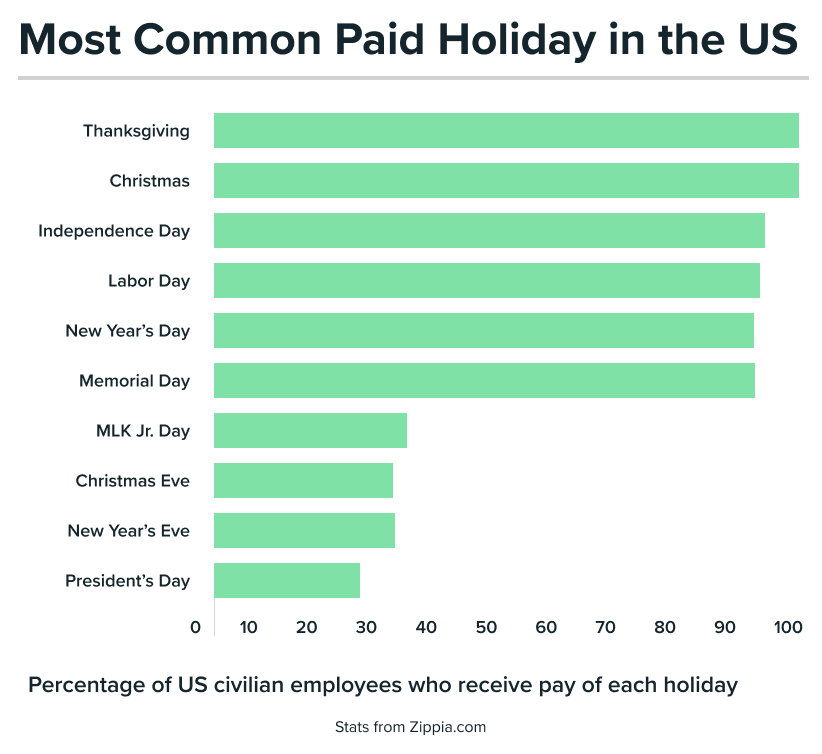
Keep in mind that state and local governments and private businesses might call these holidays by other names, but our list follows the names designated in federal law. (Federal employees in the Washington, DC, area also receive Inauguration Day as paid leave for each fourth year; this policy started in 1965.) Typically, there are only 11 federal holidays each year.

What are the Federal Holidays for 2025?

  1. New Year’s Day — Wednesday, January 1
  2. Birthday of Martin Luther King, Jr. — Monday, January 20
  3. Washington’s Birthday — Monday, February 17
  4. Memorial Day — Monday, May 26
  5. Juneteenth National Independence Day — Thursday, June 19
  6. Independence Day — Friday, July 4
  7. Labor Day — Monday, September 1
  8. Columbus Day — Monday, October 13
  9. Veterans Day — Tuesday, November 11
  10. Thanksgiving Day — Thursday, November 27
  11. Christmas Day — Thursday, December 25

Bar graph showing most common paid holidays in the US.

We’re nearing what some people call the Holiday Quarter because traditional Q4s include a lot of personal PTO as well as federal days off like Thanksgiving and Christmas. These dates are known for their sales (hello! Black Friday? Cyber Monday?) almost as much as their original cultural significance.

               Read More:How the Holidays Affect Your Digital Campaigns

From a marketing standpoint, Black Friday, Cyber Monday, and the Christmas shopping seasons can increase campaign costs and change user behavior. Be ready for the holidays to affect your business and your bottom line.

How to Handle Religious Holidays at a Secular Company

Handling religious holidays at a secular company requires a thoughtful and inclusive approach to respect diverse beliefs while maintaining a neutral work environment.

Here are some best practices to consider:

  • Establish a Clear Policy: Create a clear, written policy on time off for religious holidays that is communicated to all employees. The policy should outline how requests for time off will be handled, ensuring fairness and consistency.
  • Offer Flexible Leave Options: Allow employees to use personal, vacation, or floating holidays for religious observances. This flexibility enables employees to take time off for their specific religious holidays without requiring special treatment.
  • Accommodate Requests When Possible: Make reasonable efforts to accommodate requests for time off for religious holidays, as required by law, unless doing so would cause undue hardship to the business.
  • Foster an Inclusive Environment: Encourage a workplace culture where employees feel comfortable discussing their religious needs with HR or administration.
  • Avoid Scheduling Conflicts: Be mindful when scheduling important meetings, deadlines, or company events, avoiding dates that coincide with major religious holidays whenever possible.
  • Consider a Floating Holiday System: Offering floating holidays gives employees the flexibility to observe religious or cultural holidays that are important to them, ensuring they feel respected and valued.
  • Maintain a Secular Tone: Ensure that company-wide events and communications remain neutral and inclusive, avoiding favoritism toward any particular religion.

By implementing these practices, a secular company can respect the diverse religious needs of its employees while maintaining a fair and inclusive workplace.

How to Handle Holidays Online Without Getting Canceled

Recognizing holidays on social media can be a valuable way for companies to engage with their audience, but it should be approached carefully to avoid backlash or potential missteps.

Of course, you want to be social (it is social media, after all), which means a degree of personality and candid content. But you also don’t want your company to be boycotted for putting their foot in it.

Here are a few social media best practices to keep in mind:

  • Stay True to Your Brand: Focus on holidays that resonate with your brand identity and mission. For example, a brand focused on sustainability might highlight Earth Day, while a medical company might recognize awareness dates that emphasize health and wellbeing.
  • Be Inclusive and Sensitive: When recognizing holidays, be mindful of cultural and religious sensitivities. Ensure your messaging is respectful and avoid making assumptions about how people celebrate. Inclusivity can help prevent backlash and demonstrate your brand’s commitment to all potential customers.
  • Research and Plan Carefully: Take the time to understand the significance of each holiday before posting. Avoid superficial or generic messages that could be seen as insincere (at best) or tokenism (at worst). Planning content well in advance allows for careful consideration and review.
  • Engage Authentically: If your company chooses to recognize holidays, do so authentically. Engaging in performative recognition can backfire. If a holiday doesn’t align with your brand, it’s okay not to comment on it.
  • Monitor Responses and Adapt: Pay attention to how your audience reacts to holiday posts. Use feedback to adjust your approach in the future, being willing to learn from mistakes and improve.
  • Consider Opting Out: If your brand’s position or audience makes recognizing certain holidays potentially controversial, it may be wise to opt out. Silence can sometimes be the best option if the risks outweigh the benefits.

Whether a company should recognize holidays on the company’s social platforms depends on its understanding of its audience and brand identity. For example, if you sell Christmas ornaments, posting about the Christmas holiday is a must. If you work for an international secular non-profit, referencing the winter season would be a safer (and kinder) approach.

Even beyond the topic of holidays, it’s true: Thoughtful, well-researched, and inclusive content can enhance brand engagement, while poorly executed posts can lead to backlash.

How Many “National Days” Do Americans Observe?

Beyond federal holidays and common religious observances, we now have other “national days” that are often posted about on social media and sometimes celebrated in office, though employees are rarely awarded time off for these occasions.

Some people think we’ve taken the concept of “national days” too far. And, they might be right. There are more than 1,500 “national days” each year, along with a barrage of accompanying hashtags aimed at boosting corporate marketing goals.

For example of how companies monetize these “days,” creating them for advertising and marketing purposes, think about the current trend (and pressure) to ask a date to high school prom in the most spectacular way possible. Did you know that “National Promposal Day” (March 11 each year) was founded by Men’s Wearhouse to make sure high schoolers are asking their date to prom with plenty of time to get tux rentals. Did you know that “National Little Red Wagon Day” was created by Radio Flyer?

In 2024, March 28 alone contained 10 “days” to recognize (and that doesn’t even cover the awareness “weeks” and “months”), including “National Black Forest Cake Day,” “National Something on a Stick Day,” “National Weed Appreciation Day,” and “Respect Your Cat Day.”

Cat looking through a hole in a piece of paper.

Most of these days come with their own hashtag and promo kits, but trying to recognize all of them on your social media would be a mistake. Not to mention require three full-time jobs.

It’s good marketing practice to be aware of federal holidays, religious observances, and even speciality days/weeks/months that are related to your industry. This awareness will help you determine your company holidays, respect employee traditions and cultures, and create a social media calendar with posts that reach your target audience without exploiting them.

Best Practices for Handling Holidays in House

Regardless of the dates you decide to observe as a company, remember this three-step guide:

  1. Create
  2. Communicate
  3. Plan

Create a calendar and clearly communicate it to all employees so the entire team is aware in advance of the paid holidays that will be observed.

Plan ahead for these holidays since “observing” them means employees will not be working those days. This includes making sure your staff has met deadlines in advance, delivered any projects to clients that would be due in their absence, and communicated with their clients or customers about the closure.

It’s a good idea to have a company-wide protocol regarding out-of-office email statements (with emergency contact information) for individual employees to use for holidays and PTO.

Remember that your clients may also take an extended OOO break around federal holidays, so external communication and planning are also paramount.

Finally, it’s smart to have a back-up plan in place in case an emergency occurs (like an entire website or online ordering system goes down) while people are on leave.

Best Marketing Agencies in Town

If you need more advice on this topic or other business matters, let us know. You have objectives. We have solutions.

Plus, when it comes to social media management and marketing best practices, we’re the cat’s meow (once a cat gets stuck in your head, it’s hard to get it out).

At Liquid Creative, we work with clients all over the state and across the country. We’re an in-house team of Operations Managers, Account Managers, Strategists, Writers, Designers, and more — all working together to bring your ideas to life.

If you need assistance to boost your brand and sales, we can help. Contact us today to see what we can do for you.

Take a ‘note’ from Tumblr – How the forgotten platform can give you an edge

shutterstock_241862437-300x200-9207758Tumblr, the microblogging and sharing website created in 2007 by David Karp and owned by Yahoo! Inc., is what many Internet savvy users consider the underbelly of social media. We go there to learn something, we go there to be inspired, we go there to connect, but it is not the first place businesses go to establish or further social media presence.

In fact, Tumblr is often forgotten or opted out of completely in social media strategy.  However, the current goal of many businesses is to differentiate their brand among competition and Tumblr might serve as the next place to not only extend a campaign, but also find inspiration for fresh company blog content to engage with an audience.

As of January 2015, Tumblr supports more than 216 million blogs with a growing corporate/business sphere. That is a huge reach opportunity for executed social media strategy.  Rather than lamenting over Tumblr as a missed opportunity, consider why starting and maintaining a corporate Tumblr account as a component of social media strategy stands to benefit your brand.

1. It’s FREE!
Blogs, deemed tumblrogs by users, are free to create and maintain.  The benefit of connecting over a free social media service outweighs cost because there is no cost to consider or compare to.

2. Backlinking
Backlinking serves as indications for SEO (search engine optimization). It lets strategists know who is viewing a page or post, as well as giving value to how much impact that post makes through exposure.

Backlinking feeds into the idea that Tumblr serves as a content testing ground, which is significant if you want to spend marketing dollars effectively on other social media.  Starting on Tumblr is a way to gauge reactions to new content like articles, memes, photos, and gif sets.

3. Expand on idea of converged media
A blog allows for the generation of content as well as linking to other big traffic social media accounts. Additionally, it is also another great way to connect and feature users by sharing their posts, monitoring their tags, actually tagging them, or featuring consumers using products. Tumblr is a way to achieve a quirkier form of connection with your audience, adding another dimension to interaction.  Interaction in turn furthers company-consumer relationships and brand recognition.

4. Be Inspired!
On Tumblr, nothing is too crazy to work or too strange to not make an impact. The best posts can happen at any time of day and great content gains momentum almost instantaneously.  Tumblr is a resource, not an expense!

Something important to keep in mind is that Tumblr is not necessarily a platform you should look to if the goal of social media strategy is to drastically boost sales.  Numbers can still be tracked by online point-of-sale metrics, but the true value of Tumblr is creating brand awareness in a potentially unaware community, as well as developing engagement with existing consumers.  With the potential to increase your social currency and presence, Tumblr is the no-longer-forgotten platform to be incorporated into your next social media strategy campaign.

Here are a few of our office favorite Tumblr pages:

  •      Popsonnet puts a fresh spin on classic literature
  •      Literary Starbucks imagines the coffee orders of iconic literary figures
  •      Design before computers is featured in History Is Mine
  •      And, of course, the ultimate self-branding queen, Taylor Swift

Photo Credit: 2nix Studio / Shutterstock.com

Social media marketing – what matters for 2015

shutterstock_189811238-300x207-5210502What can a business say about social media? Some consider social media a tool with tremendous opportunity to reach consumers, while others are not even sure how to approach social media strategy. Regardless, businesses agree that social media is as much of a mystery as it is a necessity.  There is no specific algorithm to being successful, and there is no post guaranteed to keep a brand relevant.  Success varies with content generated and shared, but is highly dependent upon reactions and engagement from consumers.

According to Fortune, within the next five years businesses are projected to allocate upwards of 25% of a marketing budget to social media strategy and content generation. Currently, about 9% of budgets are dedicated to social media.  The trick, both for the present and the future, is finding where these dollars are making a difference.  Upon evaluation, many company marketers struggle to see and articulate where their social media dollars made an impact.

That is not to say their efforts failed.  The results, or lack thereof, are interpreted as reflections of how quickly social media progresses.  To an extent, social media changes hour-by-hour, and it becomes the challenge of the company to match speed.  So, all this being said, how do businesses stand to work with, rather than struggle against, the breakneck speed of social media as it changes in 2015?

1)   Focus on optimization – Social media is not just a constant output of new information, it’s about the value of information and the ability to retain consumer attention and loyalty.  Rather than spending money on continually producing new campaigns, companies are looking to using metrics, which allows for efficient analysis of social media efforts. Sites like VidYard, SocialRank Index, Google Analytics, and Nimble monitor the impact of social media over the course of time, as well as offer comparisons to competition.

2)   Focus on personalization – Catering to the specific needs of consumers is paramount to utilizing social media in 2015, as targeting audiences through larger traditional media, such as TV, is no longer an efficient use of resources. Ads specific to consumers’ personal search history or purchase habits already pop up on popular social media, like Facebook, but the new wave of strategy deals with personalization across devices.  New advertising and social media obstacles include transferring advertisements from tablet to computer, as well as effectively using real time customer data to make the sale.

3)   Focus on mobile compatibility – Once considered the second stage of advertising, mobile as a platform is predicted to come into its own in 2015.  It is no secret that society is moving to mobile, with people on or using their phone almost every hour of the day. What does that mean for advertising? Independent strategies for independent devices, each with their own unique merit.  Easy-to-navigate interfaces and interactive content will define who stands out in the mobile realm.

While strategies may differ, there is no mistaking the domination of social media as a main component in marketing for the year ahead.  With the ability to reach an almost unlimited number of people, the flexibility to execute multimedia campaigns, and the capacity to be analyzed for effectiveness, social media remains a rapidly growing powerhouse in business strategy.

Get on Google

“Just Google it.”

We bet every one of our followers understands that phrase. Google is by far the leading search engine in the world, and in the past few years has become a leader in social networking as well, encroaching on Facebook’s territory of connecting online.

Yesterday, Google announced Google My Business – a free service that consolidates the confusing process of registering your business on Google Maps, Google Search and Google+. If you’ve already “claimed” your business on Google, this change will just be an upgrade. For those who have yet to “Get of Google,” you’ll have a better experience than if you’d registered a week ago.

We are particularly excited about this upgrade in the PR world because businesses will now be able to respond directly to their Google reviews! Plus, you can update your business followers similarly to Facebook with industry news, interesting photos, company events while interacting with customers and other businesses.

Want to try it out for your own business? Go to www.google.com/business and let us know how it goes on our Google+ page! Happy connecting!

P.S. If you’ve had a great experience with Liquid or our staff, review us on Google here!


3 Ways Social Media Can Help Your Business Thrive

Until the past few years, social media seemed to belong exclusively within the territory of tech savvy teens using sites like Twitter, Facebook and WordPress to deliver their thoughts to a (supposed) audience.

Now, it seems that there has been an overnight revolution in the way businesses, both Fortune 500 companies and tiny start-ups alike, are viewing social media. Companies are realizing that social media is more than a side errand that brings negligible traffic, but a platform to attain a digital presence and increase visibility.

This is the age where droves of consumers are turning to the Internet to find dinner recommendations, product and service reviews and vacation rentals. Scratching out your own digital space is easier and less expensive than other marketing strategies, but can drive visibility, traffic and sales.

Gain Exposure to a Varied Demographic

Social media, particularly Facebook, allows your company to specifically target certain demographics. Reach young women on Instagram, Tumbler and Pinterest. Find business professionals on Google+ and LinkedIn. Denny’s official Tumbler has recently gone viral for not only their mouth-watering pictures of pancakes and bacon, but also for their quirky and witty posts that have reached thousands of “reblogs” and “likes.”

Build Brand Awareness

Promote your products and services online, every day! Cheerwine reminds their fans on Facebook that their drink is tasty and appropriate for any time of the day, as well as offering Cheerwine discounts and encouraging them to support their favorite brand #MasonDixonMadness.

Engage Directly with Consumers and Potential Customers

Online users can now retweet Amazon and add their satisfaction (or lack of) with their most recent purchase. This feedback and modern-day “word-of-mouth” helps this online mogul thrive.

amazon-300x249-5261103

Social media has been around for a while now, and advertising there is on the rise. What is your favorite social media advertising tactic? What annoys you? What’s effective to you? Share your thoughts on our Facebook wall!

Stay Connected Online This Summer

screen-shot-2014-04-25-at-1-56-15-pm-300x145-1982025

The weather’s getting hotter, the days are getting longer and vacations are being booked, which can only mean one thing. It’s almost summertime! By Florida standards, at least. For smaller businesses, all the excitement and activity of summer is the perfect time to revamp their social media presence.

Social media is one of the best ways for businesses with limited advertising budgets to stay connected with customers. By being part of Twitter, Facebook and other widely used platforms, businesses can keep their publics updated and informed – even when business might be slow.

Keep your accounts updated

Many businesses are on social media but post very irregularly. Make a goal to post an interesting news article, business update or special at least once a day. Include a link or picture with every single post because it’s proven to increase fan engagement. Don’t get discouraged if you have little engagement at first. As your fan count grows, adjust to producing the content they want to read. The Facebook Analytics feature is great for gauging what that content is.

Join a new social media site

Being involved with multiple social media sites is always a plus because it improves your SEO, or search engine optimization, and makes current and potential customers find you more easily online. If you have your Facebook presence on lockdown, consider expanding to Twitter or Pinterest.

Be engaging

We recommend downloading the “Facebook Pages Managers” application on your smart phone so you get notifications when anyone comments on or messages your company page. As your fan count grows and more people interact on your page, you’ll need a fast response time to keep them engaged. And don’t be afraid to ask your fans questions. “How is everyone’s summer going?” shows that you’re interested in two-way communication and gives the opportunity to know fans on a personal level.

We strongly recommend using innovative methods to connect with fans on Facebook. Hosting contests, highlighting employees and tagging them in the posts, and offering specials are a few proven ways to maximize your social media presence.

screen-shot-2014-04-25-at-1-49-58-pm-150x150-8727807
Halley Wharton interns at Liquid Creative Studio while attending the University of Florida for Public Relations.

Integrating Social Media and Your Website

We might as well accept it, social media is taking over the web.  As of December 2011, 64% of all internet users in the US are on Facebook, which boils down to 50% of the US population as a whole.  It’s a powerful thing, and is changing the way we use the internet.  While Facebook is by far the most popular social media platform, its still just one among dozens of others.  If used wisely, social media can be an invaluable tool when partnered with your website to expand your web presence.  Best of all, its free!

Small businesses can be one of the largest benefactors of social media.  Social media is free to setup, and instantly gives businesses the ability to provide real time news and updates through their social media followers.  We will elaborate on how to utilize social media more in future posts, I am going to focus briefly on how social media can be utilized on your website.  When a small business has their site up and running, one goal for the business should be to attract visitors to their social media pages.  If you can get someone to ‘Like’ your page, you instantly have direct real-time communication with that person (and often the people in their network).  We want to encourage visitors to connect with your business on social media.  Having a facebook feed in your website is an option, or simply putting Facebook share icons, or ‘like’ buttons in your website’s posts can get your content on social media without people needing to ‘like’ your business.  Any way to get people to share your website content, or mention of your business on social media is beneficial.  Think of social media as a pond or a spider web.  Getting your content shared on facebook can cause a ripple effect  carrying your content to each visitors unique social spider web.  It’s only one click from the visitor.  Getting interesting content on your site, and making the social media sharing options visible (and not intrusive) should be a goal. Continue reading